Splenda is not so splendid

Yet another reason I’m not a fan of Splenda…….corn.
What, you ask, do corn and Splenda have in common?  If you take a look at the back of a Splenda packet, you’ll find a very imporant word: Dextrose.

Dextrose is a sugar derived from corn.  The same plants that gives us high fructose corn syrup also produce dextrose.  Now, dextrose can also be derived from other things, like grapes, but much of the dextrose we eat comes from corn.

Why all the hype about corn?  What gives?  Corn continues to be a hot button because we are over-using it; the typical American approach: Something has a good aspect to it, so we exploit it and over-work it, and then wonder what went wrong.  Our food (including dairy, meats, legumes, grains, etc) is at least 25% corn-based, from the reading I did in both “Omnivores Dilemma” and “Fast Food Nation” recently.  The reason is that many of our lifestock eat corn, so we get the residual issues in our bodies.

Corn sensitivity, like gluten or dairy sensitivity, is on the rise.  Of course it is – when we over-consume something, our bodies get sensitive to it.  It’s like being poked in the same spot on your arm 1,000 times.  Sure, a poke every now and again isn’t so bad, but constant poking yields a bruise, dysfunction on the skin and sensory feedback and general irritation.  Same with food.  We over-eat something ,especially if that something is genetically modified (and you can be your bottom dollar Corn is genetically modified, especially nowadays).
The other reason artificial sweeteners don’t excite me is that they miss the point: we are addicted to sweet.  Wouldn’t you (who are also fellow addicts like me) agree that once you get the taste for sweet, it’s over?
Americans consume a lot of sugar, we all know that
What I think is under-represented is the genetic and biochemical drive to consume that sugar even when we know it is not good for us.  What would serve us better are foods/recipes/mindsets that help us put our sweet craving aside.

In Chinese medicine it is said that a sweet addiction is an addiction to “the sweetness of life”.  We want it to taste like honey all the time, and when it doesn’t, we go looking for the honey.

I can certainly see this in myself.  I’ve used sugar as a compadre to cope with the drama in my head for many years.  Without it, life still seems a little sour, and yet with it I am a slave to its effects.

I suppose the call to action here is to invite myself and others to look at the role sweet foods play and ask ourselves if that role is really suiting our life’s dreams?  And for the times when something sweet would be really appropriatae, why not make something real, good and of the earth?
For such an occasion, I have a recipe.  Maybe its weird to post a dessert recipe here, because I’m talking about abstaining from sugar, so this one is for the birthday party, the 4th of July picnic, or whatever else is a call to celebrate.

I have to thank Better Homes and Garden’s for the inspiration.  I was looking for a recipe for a birthday potluck at work and my new mag came to the door, offering a recipe that catapulted me into creative recipe creating mode.

Blueberry-lemon-coconut-pie (and low sugar too!)

1/2 cup virgin coconut oil
3/4 cup whole oats (you can blend them for 30 seconds for a finer flavor, if you’d like)
1/2 cup spelt flour
1/2 cup unsweetened coconut
2 tsp cinnamon and nutmeg, each
1/2 cup flaxmeal
1/4 cup sucanat

In a small saucepan, heat coconut oil over medium heat until melted and warmed (1-2 minutes).   In a med bowl, stir oats, flour, coconut, flax, spices, and sugar.  Stir in butter and mix.  Press into the bottom of a 10″ pie dish, or 13″x9″ pie dish.  Bake at 350 for 10 minutes.

Filling:

6 eggs (or 3 eggs + 4 whites)
1/2 cup spelt flour
1/2 cup fresh lemon juice
3/4 tsp baking powder
1/4 tsp nutmeg
1 tsp lime peel
2 cups blueberries (I warmed 2 cups of blueberries on the stove w/1 packet Stevia to bring out flavor prior to adding)
1/4 cup sucanat.

In a medium bowl combine eggs, sugar, 1/2 cup spelt flour, lemon juice, baking powder and nutmeg.  Beat for 2 min.  Stir in lime peel and berries.  Pour over crust.  Bake 30 minutes at 350.  Serve chilled after 2 hrs of refrigeration.

This one was a hit with all the co-workers, even those who don’t normally eat healthy.

I’m learning the power of having a well planned, special treat on occasion versus the daily consumption of “junk” sugar, which doesn’t actually make me feel good, and certainly doesn’t add anything to my health.

Blessings

R

More on the price of convenience: a NEAT perspective

Recently a fellow blogger, named Jeff, wrote this:

  1. The average long haul truck driver leads a sedentary life and stops at travel centers 5 times each day. Their diet is heavy on snacks and all-you-can-eat buffets. It should come as no surprise that 73% of professional truck drivers are overweight or obese, more than twice the national percentage. Truck drivers may “celebrate the cost savings” but their bodies are clearly paying a greater price.

Yowza!!  5 times/day…….that is crazy.  This topic reminded me of something I was recently reading in a Mayo Clinic newsletter.  It was a discussion on the epidemic of obesity due to lack of physical activity.  Truck drivers are certainly examples of a population who both move very little AND eat very calorie-dense foods.

So, I did a little research on something called NEAT:
you can check it out at this Mayo clinic link.

NEAT: NON-EXERCISE ACTIVITY THERMOGENESIS

Introduction
Looking out over this crowded coffee bar, I see a 40-year-old man reading a newspaper. He is stationary. He sits next to a 30-year-old woman. She can barely sit still. She gets up and curves between the tightly squeezed tables, just to get a napkin and then gesticulates wildly as she talks on her cell phone. He has still not moved. He thinks now of his three-year-old daughter at home; “she just never stops” he thinks. He smiles to himself and scratches his nose. She gesticulates further as she tells a friend of a rat she saw scuttling rapidly on the subway rails. A taxi drives by. The driver immigrated from an agricultural community in the Ivory Coast. Birds soar high over-head. All these living beings exhibit spontaneous physical activity or, Non-exercise Activity Thermogenesis (NEAT).

Human Energy Expenditure (and semantics)
Even lean individuals store at least two to three months of their energy needs in adipose tissue whereas obese persons can carry a year’s worth of their energy needs. It is the cumulative impact of energy imbalance over months and years that results in the development of obesity or undernutrition.

There are three principal components of human energy expenditure (EE), basal metabolic rate (BMR), thermic effect of food (TEF) and activity thermogenesis. There are also other small components of EE that may contribute to the whole, such as the energetic costs of medications and emotion.

BMR is the energy expended when an individual is laying at complete rest, in the morning, after sleep, in the postabsorptive state. In individuals with sedentary occupations BMR accounts for approximately 60 percent of total daily EE. Three-quarter’s of the variability in BMR is predicted by lean body mass within and across species. TEF is the increase in EE associated with the digestion, absorption, and storage of food and accounts for approximately 10-15 percent of total daily EE.

Activity Thermogenesis has two constituents, exercise-related activity thermogenesis and Non-exercise Activity Thermogenesis (NEAT). For the vast majority of dwellers in the U.S., exercise activity thermogenesis is negligible. NEAT, even in avid exercisers, is the predominant constituent of activity thermogenesis and is the EE associated with all the activities we undertake as vibrant, independent beings. NEAT has an enormous variety of constituents including occupation, leisure and fidgeting. Because of this, NEAT is challenging to study and its role in human energy balance has been difficult to define.

Non-exercise Activity Thermogenesis (NEAT)
NEAT is likely to contribute substantially to the inter- and intra-personal variability in EE. Argue thus; if three-quarters of the variance of BMR is accounted for by variance in lean body mass and, TEF represents 10-15 percent of total EE, then the majority of the variance in total EE that occurs independent of body weight must be accounted for by NEAT. Evidence supports this. NEAT is highly variable and ranges from ~ 15 percent of total daily EE in very sedentary individuals to >50 percent in highly active persons . Even minor changes in physical activity throughout the day can increase daily EE by 20 percent. NEAT is impacted by environment, but is also under biological control .

NEAT and environment
There are many environmental cues that impact NEAT. Broadly, they can be divided into occupational and non-occupational components.

NEAT and occupation
Matched individuals with highly active ambulatory jobs can have NEAT values of 1000 kcal/day greater than sedentary peers. In areas of nutritional need, this has implications for starvation-threatened individuals. In affluent countries, industrialized can convert high-NEAT jobs to lower-NEAT jobs and this has been associated with increased obesity rates.

Non-occupation NEAT

  • Dish washers
  • Cars
  • Remotes
  • Lawnmowers
  • Drive-through
  • Game-boy
  • Elevators
  • Snow blowers

Leisure-time sedentariness has resulted from the availability and volitional use of pervasive mechanization. When the energetic cost of non-work mechanization is estimated experimentally it approximates to, 100-200 kcal/day; a caloric deficit that potentially could account for the entire obesity epidemic.


NEAT and physiology
With experimental overfeeding in humans, NEAT increases. Those who increased their NEAT the most with overfeeding gained the least fat. This suggests that along with self-evident societal slothfulness, NEAT is biologically modulated. Animal data support this. There appear to be central mediators of NEAT. For example, microinjections of orexins into hypothalamic nuclei increase NEAT whereas antagonists decrease it. There may be humoral mediators as experimental hyperthyroidism is associated with increased NEAT. There also be genetic mechanism at play; during overfeeding twinness in part predicts fat gain. Also NEAT is specific for different genetic strains of mice.
Where to from here?

Mechanism: by understanding the neuromodulators and non-central mediators of NEAT; its biological function will become clear.

Physiology: What are the key components of NEAT? What is the role of NEAT in aging, children, gender, and race? How does positive and negative affect NEAT and its components?

Pathology: What is the role of NEAT in obesity and eating disorders?

Intervention: Targeted, evaluated interventions from person to population.

Having read this abstract, please get up and take and short walk down the corridor (or similar). Repeat for each abstract you read. Please let me know how it went.

Stress and sugar, Part III: HOW TO GET OFF SUGAR

Ever wish you were the kid picked to visit the chocolate factory in the Willy Wonka stories?  Ever make up ridiculous fantasies in your mind about larger-than-life candylands?  Yeah…me neither…. 😉  But if you did, or still do, this post is for you.  First, a video titled “I want candy”

So, basically, this post is the summation of my whole blogging purpose. GET OFF SUGAR. Do it now! Don’t wait until you have diabetes, arthritis, obesity, depression. Of course, if it were easy, I wouldn’t have a blog, a job, or half of the life experiences I have been blessed with. I suppose being human means that some things are not easy.

I’ll be honest. I am not 100% off white, but I am about 90% off white sugar, 100% off white flour (90% off wheat altogether) and 100% off milk, cheese and yogurt. I feel a lot better, have less sugar craving, and I poop regularly. Seriously, being chronically constipated and ‘full’ all the time was a MAJOR side effect of eating too much sugar and dairy.

So, if you want to get off sugar, here’s what I suggest:

1. Find your willingness. Before you do anything with your diet or lifestyle, you have to find that strong desire for something different. What are you willing to change about your diet? Are you willing to stop drinking soda altogether? Are you willing to have fruits or pass altogether on dessert? Are you willing to spend 3-4x as much for unrefined grains/flours/sweeteners so that you can feel better.

No question is more important than the question of your willingness. On a 1-10 scale, how willing are you to do what it takes to get off sugar. Don’t be upset if its not a 10. Rarely is a sugar addict stoked about this process. But, look for what you ARE an 10 on. For instance, I was a “10” in a willingness scale to give up all candy on Feb 28, 2004 (first day of lent – I quit candy and never looked back), but about a 3-4 to give up hot chocolate. So, now I just make healthier hot chocolate and that helps. You have to start where you are and continue checking in with that willingness.

Let’s say you’re willing and ready. Next steps;

  • Give yourself a 3-7 day detox period. If you want to do a colon cleanse, that can go on for longer, but clean up your diet for a few days. For me, this means none of the following: wheat, corn, dairy, caffeine, chocolate, alcohol, sugar, fake fats, artificial sweeteners. You will be instead eating TONS of veggies, fruits, lean meats, eggs, olive oil, coconut oil, whole grains like brown rice, etc.
  • After your detox phase you might crave sugar a lot less already. This is good. Start drinking lots of water. Flush out all the “junk” and cell “memory” of wanting sugar. Your body remembers what you’ve always done and its used to it. If you drank a lot of sugar in soda or beverages, replace the habit with water. Just do your best. Get support if you need it (or start a blog to blab about it, like I do!)
  • Eat protein at every meal. Vegetarians won’t like me much because I advocate more meat consumption for those kicking sugar than some people might be comfortable with. The reason is that lean protein, esp animal protein, helps stabalize blood sugar, which is KEY in kicking sugar. Also, if you use high quality meats, then you are getting B vitamins, healthy fats, iron, as well as protein. You can certainly eat things like beans, tofu, lentils and nuts, but I find carb-based proteins to “confusing” for my body at first.
  • Balance that carnage with a boatload of green veggies. You just can’t have too many. Eat 1-3 cups of green veggies/day, cooked or uncooked. Suggestions are: mixed green salads, adding spinach to omelets, steamed asparagus, soups with zucchini, leeks, bell peppers, collards/kale, snap peas, etc.
  • Express your feelings. So much of our desire for sugar is to taste the “sweetness” of life. What are you really craving? Write about it, talk about it, go for a walk or jog to blow off steam. Whatever you do, get your voice and your ideas heard.
  • Get rid of all the white stuff in the house. Its a conflict to your mind when you are saying “no” and you still have white sugar/flour. Maybe for a while you keep none in the house. If you must bake or cook with sugar/flour, use sucanat, agave nectar, molasses or stevia. Use whole wheat flour (less ideal, but okay), spelt flour, oat flour, or get to know gluten-free flours. check out www.glutenfreegirl.com if you want some good gluten-free baking recipes.
  • Cleanse your liver. Start a practice of hot water with lemon in the morning. This will help “lube the tube” as well as detox the liver. If you have a long history of processed foods, your liver needs a break. Other liver cleansers include: stinging nettle tea, green culinary herbs, asparagus and milk thistle. Bitter veggies also cleanse the liver.
  • Educate yourself about reading labels and finding healthier alternatives to the foods you used to eat. Some things can be modified to have less sugar, such as baked goods and cereals. Other things, like marshmallows or store-bought cookies, are pretty much not and option if you want kick sugar. You might have to pick and choose what its important to you and then let the rest go.
  • Find out if you have any food allergies. My sugar obsession was made worse by my dairy/soy allergy. I had no idea until I was tested. I think I mentioned this before, but check out Diagnostech if you want to do some testing.
  • Take it day by day. Progress, not perfection will help you move toward freedom from the white stuff. You can do it. I believe in you. I don’t even know you, and I believe in you because I was the toughest sugar junkie ever and I’ve made it to the other side…..or at least to where sugar is the exception and not the rule in my life anymore.

Silly me, I forgot that I have Candida

I was doing some paperwork “purging” and came across the lab results from all my testing I had done last year.  The testing came about because I was always feeling run down, had chronic constipation despite a high veggie/fiber diet, had voracious sugar cravings, and got sick all the time.  Amongst other issues the test results were loud and clear: Candida.

To make it short, Candida Albicans is a yeast that lives in the body.  It is the yeast responsible for “oral thrush” in HIV and cancer patients, and yeast infections in women.  Normally we have some in our gut.  When it gets out of control, it often creates major upsets in the GI function because it messes with the eco-system of your intestines.

It also craves sugar, its primary food source.  That is what screams at me to have some high-sugar fruit after a nice protein/veggie meal.  That is was whispers in my ear that a stop for hot chocolate “just this once” is a good idea.  That is the name of the voice which tells me to put an extra 7 teaspoons of agave in my tea.  Its ridiculous.

When I was diagnosed, my diet changed dramatically and for a while I was on the straight  and narrow.  My digestion improved and I felt good again.  lately, I haven’t been so dilligent.

Getting rid of candida is serious business: No high sugar fruits, no fruit alone, gluten-free grains oil, and LOTS of damn green veggies.  GoodNESS you have to eat a lot of green veggies.  I think I rebelled against the strictness and started enjoying things like dates and agave nectar and raisins.  Harmless to the ‘normal’ person, but I am hardly normal.

So I’m glad I found those results.  They humbled me again to realize that I eat for health, and not for my ego.  My body is pleading with me for balance, so its important for me to honor that plea.  The voice of the Candida is very tricky and easily mistaken for truth.

One thing I do when I’m  trying to cleanse my body of sugar craving is this:

1 cup of warm but not boiling water
Juice of 1/4 lemon
1-2 tsp of Bragg’s Apple cider vinegar

Mix and enjoy.  Its not tasty, but it cleans the GI tract and Candida hates it.  Score 1 for me and none for the Candida.  In fact, I’m drinking it right now and feeling  grateful that I know what my body needs…..now to only do it everyday……

Part III of sugar and stress to come.  But this is like an add-on to that topic, as Candida is certainly triggered by stress.

Sugar and Stress, Part II:

This is your body being healthy:

This is your body on sugar:

I can’t believe how long it’s been since I posted. Clearly a sign of being just too busy and not balanced…and what do ya know: my desire for sugar has been higher the past week than in a while.

Stress is an odd little monkey in my body . While the real solution to excessive stress is relaxation, deep breathing, fun, peace….yada yada yada……my body-mind seek things that keep the perpetual wheel of anxiety going: more activity, more stimulation…and more sugar.

Life is so clever. It never ceases to amaze me how I’m always being brought little lessons that remind me to pay attention and keep doing my personal growth work. Just as I decided to blog about sugar and stress, more of “that” kind of stuff pops up in my life. We teach what we need to know, don’t we?

This week really wasn’t too bad, however. I did dive in a bit and add sugar to my hot chocolate (a rarity, usually I use stevia) and I did have some frosting on Friday. Yes, I said frosting…not cake with frosting, just frosting. A birthday celebration at lunch yielded left-over cake with white frosting AND sprinkles. Hello!!! By Friday afternoon, running off of 5 hrs of sleep for several nights, I just gave in. Thank GOD there was only a small amount of cake left. I can’t say for sure what state of affairs my ability to say “no” would have been in had I been staring down 1/2 a cake and nobody in sight to see me take a monster piece.

Some of you readers might still wonder why I am even mentioning what may seem like “small” amounts of sugar. I’m an addict. A sugar addict. There are no small infractions, no small treats. Each tiny morsel stimulates in me a desire for more that sometimes feels larger than life. I will blow off social engagements, isolate from my husband, buy crappy junk food that I don’t even like…all to feed this unsaitable craving. That is, if I’m not mindful, grounded and have done the self-care to stop this from happening.

What is the physiology of this crazy addiction? Am I alone? No way – I see sugar/carb addiction everyday of my life. I see it in my clients who don’t understand why they are so able in many aspects of their lives, but have a complete weakness for some kind of refined food. I see it in our children, who would rather zone out with video games and suck down 4-6 sodas/day (the average # of sodas an American kid drinks, according to some), and who can’t concentrate at school. I see it at the grocery store when I watch people, who look tired and unwell, load the cart with frozen pizzas, boxed cereals, bread, crackers, and maybe 1-2 fruits or veggies. We are so close to it, we can’t even see it. It is both completely socially acceptable (c’mon…just have 1 dessert) and totally unacceptable (hatred of obesity) to be a carb junkie today. American consume about over 120 pounds of sugar. What to know more about that? Check out this article by Nutritionist Dr. Nancy Applegate.

What does sugar do:

Step 1: Seek out some refined carb food and put it in your mouth. You feel stoked, happy, and can’t wait to taste the sweetness (even breads register as sweet in the body)

Cookies…mmmmm……..

Step 2: you chew that food item and your body starts to prepare for digestion of sweet. This is thanks to amylase, a mouth enzyme that breaks down sugar. Now, the design is clever: send a signal to the hypothalamus (in the brain), which signals the pancreas/stomach early so it can be prepared with some insulin. After all, these whole grains/fruits our body has been eating for thousands of years take time to break down, so amylase helps get the ball rolling.

Problem: refined sugar needs no breaking down. It is absorbed quickly in the blood stream. It hits hard, fast, and all at once.

Step 3: lots of insulin is produces once the signal of “sweet” is sent from the mouth (really its the brain experiencing the sensation of sweet) and when the sugar hits the blood stream.

Problem: Too much sugar at all once! Complex carbs break down slowly. Its like putting one box at a time on the conveyor belt. Remember the “I LOVE LUCY” episode from the YouTube video above? She couldn’t keep up, so she stuffed all the excess chocolates in her mouth/pockets, etc. It became an overload. It was stressful. Your body is Lucy when you feed it to much sugar.

Step 4: This excess sugar has to go somewhere. The liver takes some of it and stores it as glycogen. But it can only store 3-400 calories (about 100g of sugar max) at once. Over time, excess sugar consumption will stress the liver and engorge it, as it tries to force more storage of sugar while also trying to deal with all the other stuff it does. When it maxes out, it sends the sugar back into the blood stream as fatty acids. This is partly why excess sugar consumption raises triglycerides, perhaps more than fat consumption.

At the same time, this sugar now stimulates “fight or flight” response. Your adrenals start working. you get a little “high”. But it never lasts long, now does it? You can’t function as well b/c all the blood is being distributed to your periperhy. Your body is prepared to fend for its life. But there is nothing to fend for. You are sitting at your desk entering data into the computer,or watching TV, or anything else non-life threatening. Over time, the fight or flight activation stresses your body and makes you produce excess cortisol.

Also at this time, the hormone insulin swoops down and scoops up all that extra blood sugar so your brain can stay alive. Yay! Another day to live. However, that sugar ain’t coming out for free. Insulin converts sugar to fat. Lucky us- even if your meal was low in calories, if it was high is SUGAR it may go right to our rears. It took me a long time to believe this, until it started happening to me.

Problem: too much cortisol suppresses the immune system, so you get sick more easily . It also contributes to fat storage around the abdomen, in response to potential life-threatening stressors. It does not know the difference between stress caused by food and lifestyle and real, physically threatening stress.

Step 5: You crash. Your blood sugar dips too low and you get lethargic. Your pancreas is stressed b/c its having to play this insulin game all the time and its over it! It stops working well or your cells stop being as responsive.

Problem: Excess insulin production leads to weight gain (insulin stores sugar as fat in the hips, buttocks, abs, and thighs). The system poops out after a while too, which contributes to Type II diabetes, often associated with high-carb lifestyles. You also feel like garbage.

Step 6: The body is a system of habits and patterns. It comes to rely on certain processes, good or bad. After your crash and your “fight or flight”, you’ve now “up-regulated” certain processes in the body. They want to keep on working, so they now stimulate a new desire for more sugar. And the cycle continues.

Problem: some people are HIGHLY sensitive to this little phenomenon. In fact, for some people, sugar binds with other neurotransmitters in the body and moves into the brain to create “euphoria”. This high is similar to heroin. I’ve talked to ex-drug addicts who have told me kicking sugar was harder than kicking drugs. Some people (myself included) experience withdrawal when they get off sugar. Symptoms include:

  • headaches
  • dizziness, nausea
  • overwhelming urge for sugar. You think you “need it”
  • energy highs/lows
  • rapid heart beat
  • insomnia
  • constipation/diarrhea as the digestive system attempts to rebalance itself
  • change in appetite
  • anger, anxiety, irritability
  • thirst
  • skin breakouts

So you think your body needs sugar to live?

Although the body does require sugar (glucose), as this is the only fuel the brain can use, it is important to remember the physiology of digestion. The properly functioning human organism can produce all the glucose the brain needs through the digestion of whole, natural, unprocessed foods” Dr. John Yudkin of Queens College, London, states all human nutritional needs can be met in full without having to take a single spoonful of white or brown or raw sugar.”

All this just for some lousy sugar. And the high doesn’t even last. I also hate the feelings of guilt, tiredness, boredom, lethargy and low self-esteem that I get from too much sugar. It just isn’t worth it, for me.

I’m so thankful that others folks are starting to talk more freely about their carb addiction. Last night I came across an awesome book at Borders:

Confessions from a Carb Queen

Check out her blog

Okay, I’ve been blogging for way too long (these posts sure do take some time). I gotta get movin!
Have a happy, refined sugar-free day, if that’s your thing 🙂

Sugar and stress, part I

So I’ve decided to do a little piece on sugar and stress, since it is SUCH a big aspect of my life and I see a lot of the effects of s&s everyday with myself and others. One benefit of having this affliction AND being a nutritional counselor is that I get to experience the impact of food and mood or many levels.

I’m gonna do this in 3 parts because I have a lot to say about this topic, and I think its worthy of a few posts.

Here’s where I’m going to start: WHY do I emotionally (people) crave sugar when I am stressed?

When I was young , the only thing I ever wanted was sugar, sugar, sugar. I obsessed over Halloween candy. I was glued to mom’s side when she was baking, so that I could score some free licks off a spoon or spatula. I always voted for “The Sizzler” when we were picking restaurants, exclusively for the strawberries and whipped cream at the salad bar. I was a junkie.

How did this all begin? First off, did you know that sugar is the first taste we develop? Mamma’s milk is sweet. We are held when we are fed. We feel safe. It goes on and on. Sometimes new mom’s and dad’s are told to bring sugar water to the doctor’s office when their baby gets an immunization, to help calm the pain. Sugar numbs us out. It makes us high. Physically, we do not need sugar to survive. We need carbs, but not necessarily simple sugars. We might then speculate that some of us are not so equipped to handle the impact of sugar. More on that in post #2.

For as long as I can remember, sugar has been a best friend to me. It is always there, in so many shapes, colors, sizes and textures. Its cheap, its socially acceptable, and it makes me feel SOOOOOOOOOOOO good….or does it? I went years harmoniously co-existing on this continuous sugar buzz without a hitch. I bragged about the fact that I could eat a pound of red vines while grocery shopping and not gain any weight. I think I kind of liked being the candy girl. It had a certain charm. My ego devoured the attention I got over sugar. “How cool is this?” I would think to myself. Turns out, not so cool.

But, like all good addictions, it catches up. It turns out that my physical and mental body don’t like being fueled by fructose and glucose 24/7 and that as I get older, my tolerance for sweet is much less, yet my attachment to it is much greater.

The past couple days I’ve been wanting for sweet because I am afraid of change. What? How do sugar and change relate? Well, when you are trying to heal the body-mind from something that was like an old friend (sugar) in your life, and then new variables (like possibly moving to California, and making major life changes) pop up, it sends me running back to mamma’s arms: AKA hot chocolate, oatmeal raisin cookies, or anything warm and sweet.

This desire to soothe is so deeply imprinted in me, and others (I think?!), that it almost seems like the right thing to do . My brain is so good at taking the path of least resistance that I trick myself into believing that I actually need sugar to survive. When uncertainty triggers feeling of aloneness, I need security. It feels deeply carnal, like a survival instinct. My emotional body actually thinks that I will not survive without it.

In the past few years, I’ve done a lot of soul searching and book study about this crazy, wacky phenomenon of sugar-stress. Here’s what I know:

  • Sweet is the first taste we experience, and nearly all people find “sweet” palatable. Sweet includes breads, pastas, fruits and even meats, such as red meat or lamb.
  • The average American consumes 140 lb/ year of sugar in some form. That is 44tsp/day. That means we pretty much get it all the time, so it becomes a major physical and psychological habit.
  • Most kid’s can identify brands like “McDonalds”, “Starbucks”, or some sugar cereal characters before they can actually read. When our sub-conscious mind is wide open, we are bombarded with messages that these companies will provide us with fun, friendship, love and excitement if we just eat what they are peddling.
  • As a kid many of us develop the association of sweets with reward, soothing our pain, celebrating and drawing attention to ourselves (ever have mom bring in cupcakes on your b-day? Didn’t you just feel like the cool kid at school, even if just for that day?)
  • When white sugar was first developed, European conquerers used it to over-power the people they were invading. They claimed that it made wise, motivated men “stupid and lazy” (from the book Sugar Blues).
  • Sugar depresses the nervous system. If you’re a nervous nancy, like I am, you want to stop those neurotic thoughts. What a better way than some cookies and milk, or a piece of favorite cake, or some candy, or whatever…..

ARE YOU EMOTIONALLY ADDICTED TO SUGAR?

  • Do you find yourself going for breads, cookies, cakes, candy, Starbucks ‘stuff’, fruit, honey, granola bars, power bars, etc when you have had a long day, are over tired or bored?
  • Are your favorite foods in the dessert category?  Would you rather skip dinner and have dessert first?
  • Do you get edgy or cranky if you don’t have sweets/fruit/breads for a couple of days?
  • Do you fantasize about sweets, or did you used to do so?
  • What’s in your cupboard?  Lots of boxed, processed foods? Refined cereals?  energy/granola bars?  Dried fruit?  Do these items tend to get eaten first?
  • Does the thought of never having those favorite sweet treats again feel really sad or scary to you?
  • Is the concept “portion control” non-existent when it comes to certain, refined carb-based foods?
  • Are you turned off to bitter or sour foods, like dark green veggies, lemons, saurkraut, relish, etc?
  • Do you hide stashes of sweets in your car, room, desk or anywhere that nobody can see you eating them?

I’m certainly no expert on your life, but for me, I can answer “yes” to far more of those questions than I’d care to admit to.  However, when I do face my truth, I can release the guilt, shame and frustration and move forward.  There is life after refined sugar, and I’m learning how to make friends with it, one day at a time.

For those who are curious about unrefined sweeteners:  I use them in my life, but they are still sugar.  If I’m spooning agave syrup into my mouth, I’m still getting high on sugar, it just doesn’t take as much of a toll.   It’s really about why I am seeking out sweet stuff to fix my life.  It never works.  It never makes me feel better, but my brain has 31 years of conditioning to release.

If you are just starting out your sugar-free life, I have some insight and advice, based on what has worked for me:

  • Get SUPPORT!  Friends, special groups, spiritual groups, blogs like this, etc
  • Be gentle with yourself and realize it is a process
  • Begin to replace as much refined carbs with veggies, protein and water.  Protein is your friend, as are anti-oxidant rich veggies.  more on that tomorrow.
  • One day, one meal, one moment at a time.  Progress, not perfection.
  • If it’s serious, talk to your alternative health practitioner about getting food allergy or GI function tests done.  I learned  a TON about the physical reasons I crave sugar when I had tests done by Diagnostechs.   They rock!

PS: for the curious – yes, I did have some sugar today.  I made hot  chocolate w/ rice milk and cocoa.  I used sucanat instead of stevia.  Not the best  choice, but could have been worse.

Bittersweet: more than just chocolate (recipes at end)

 chocolate.jpg

Like a good piece of dark chocolate, life can be bitter sweet.  This weekend was a prime example.  The sweet part included a great snowshoe for my husband’s birthday, which included a fun day with two of our dear friends.     I even packed a healthy lunch of turkey and avocado wraps on multi-grain tortillas with veggies, and cheese.  We enjoyed a nice alpine lunch and good laughs.   The day rolled into night with an exotic trip to Morocco via Marrakesh restaurant and laughs with co-workers.

Then the bitter part: Long story short – our car was broken into and  my purse, an ipod, some clothes, and a backpack were nabbed.  Certainly an unexpected twist to our day……

But back to the sweet:  This kind of stuff unglues me, but I was able to keep my cool, deal with it all, and NOT EAT OVER IT!!!  Whenever I would think about wanting to “devour” my feelings over it, I would breathe or just talk about it.  Maybe my friends got sick of me bringing it up, but the sanity I had over releasing my feelings is worth any annoyance.  If you are like me and tend to “digest” your feelings instead of express them, you can appreciate this little victory.

I had already planned on going back to regular food this weekend, so I felt empowered in my choices at lunch and snack time after our snow adventure.  What also helped was having already seen the menu of the restaurant we attended, as I could mentally prepare for the choices available.

When I’m stressed, I must have a plan.  That plan is like my rock and makes me feel safe.  Already it can be hard when I’m with others who are eating all types of food, especially when the  continue to offer me treats and tidbits.  They don’t know that I can’t have “just one” or that all the little critters in my belly would have a party if I ate certain things.  It’s my deal, so I have to make responsible choices.

The Plan:
We had dinner at Marrakesh: a Moroccon restaurant in Portland.  I planned ahead to do the following:

marrakesh.jpg

  • Strategically have a “safe” snack pre-dinner.  For me this was a turkey/onion/mustard mini-wrap on a large romaine lettuce leaf, some tea, and a few apple slices.
  • Drink water and nothing else.  I’m not a big alcohol drinker anyway, but rarely drink when I’m out. The extra sugar is a no-go for me.
  • I avoided eating the bread when enjoying the “salad”, which was totally a finger/bread food. I piled up the veggies/hummus on small bits of bread, but didn’t eat the bread.
  • I tasted all the meat dishes, but had just enough to be satisfied.  Some of the flavors included apricot chicken, lamb with couscous, veggies and raisins (ate around the couscous), and lemon chicken with almonds.  Yum, yum, yum.   Moroccan food blends sweet and savory so well, I just love it!  Eating with my hands actually made me go slower, which helped not stuff myself.
  • Skipped dessert because I had my fill.

What’s funny about yesterday is that I’m so fired up about the fact that the stress did not make me seek out TONS of sugar yesterday or today, that it gives a little sunshine to a frustrating situation.

So, in honor of my bittersweet day, I’d like to speak about chocolate.

I truly believe chocolate can be a health food, depeneding  upon what kind you use and how much you eat.  For the health benefits look for 70% dark chocolate, which automatically means there will be less sugar.  I often keep dark chocolate bars or powder on hand to make low sugar treats because they save me from going on the deep end with sugar.

How to know if you really have a chocolate craving, or a sugar craving:

When you are really craving chocolate, a piece of bittersweet dark chocolate will alleviate the craving.  When you crave sugar, the desire is often more for milk or white chocolate (not really chocolate) because milk/white chocolate have milk sugar and regular sugar.  Beware: even hershey’s dark and the low-end dark chocolates often have only 30-50% cacao, and still have tons of sugar.

Is chocolate a superfood?  Read here and you be the judge:

·Cacao is rich in antioxidants

·Cacao has been associated with decreased diabetes & blood pressure (American Heart Association)

· Cacao is rich in B1, B2 and D vitamins, and magnesium and iron.

· Cacao is associated with improved vasodilation, helping increase stamina during exercise. (Athens Medical School)

· Cacao is cholesterol free. Its phenolic properties may also block oxidation of LDL cholesterol.

· Chocolate is associated with euphoria and reduced depression – due to phenylthylamine.

· Serotonin, a well-studied neurotransmitter, is thought to instill calm and relaxed feelings. Chocolate is associated with increased serotonin levels, a factor that is believed to explain chocolate cravings.

· Some researchers believe that
serotonin is related to premenstrual syndrome (PMS), explaining premenstrual chocolate cravings.

· Stearic acid, chocolate’s predominant saturated fat, has neutral effects on blood cholesterol.

· The European Board of Health lists chocolate as a pre-digestive aid

A  good chocolate bar also has about 3-5 g fiber/serving and contains trace minerals, like Selenium.

What about allergies?
Jeremy Drelich, MD assessed a group of 20 individuals who reported allergic reactions after chocolate consumption. After a week without eating chocolate each individual received skin prick and blood tests for allergies to chocolate and component ingredients (milk, soy, almonds, peanuts, vanilla), and consumed unlabeled cacao and non-cacao samples. Sugar allergies were assessed by giving half the participants unsweetened chocolate and half chocolate made with cane juice. None showed definite evidence of a chocolate allergy, though some tested positive for non-cacao ingredients. By choosing organic products made without additives or fillers – such as organic dark chocolate made without refined sugar – you’ll may find yourself happily reunited with chocolate.

http://www.webmd.com/news/20040601/dark-chocolate-day-keeps-doctor-away

Feeling bittersweet? Try these low or no sugar recipes:

CHOCOLATE COCONUT MACAROONS

3 cups shredded coconut
1/3 cups cocoa powder (substitute same amount of almond flour for
blonde macaroons)
1 cup maple syrup
1/3 cup coconut butter (I found at New Season’s)
1 Tb. vanilla extract
1/2 tsp. salt

Mix all ingredients in a bowl until moistened. Refrigerate for about
an hour just to make forming the balls easier. Form into balls.

Dehydrate @150 for 12 hours or place on a cookie sheet for roughly 5 – 7 mins @ 350 degrees. This just gives it a little crispness on the
outside.

CHOCOLATE MINT DISKS
Pour I cup coconut oil in a bowl. If oil is solid,place it in a double boiler and heat gently to the liquid state.

Add 1/2 C. dark chocolate or 2 to 3 tsp. cocoa powder . If using chips/chunks, melt chips with solid coconut oil, or melt and add to liquid coconut oil.
Stevia- 2 droppers or to taste.
Peppermint oil- 3 drops
Add chopped nuts, seeds or unsweetened coconut to taste.( raw sunflower seeds, flax seeds, sesame seeds, pumpkin seeds, or any nut in raw state, excluding peanuts.) 
Pour mixture into pie pan and refrigerate.
Cut into squares before they get too hard or set them out for a few minutes and let barely soften to cut up.  You can also use a small mold for convenience.

groceries: $100. Making good food choices: priceless

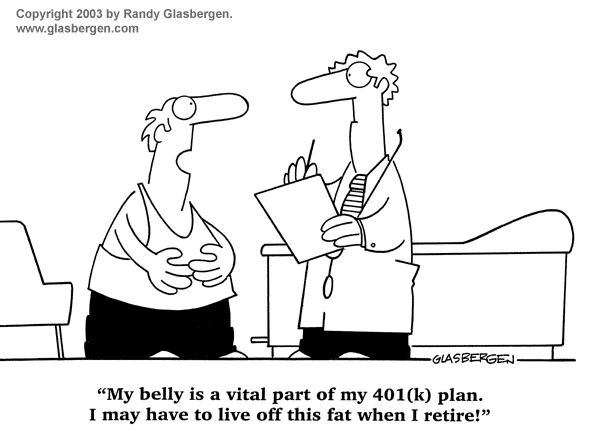
cartoon

In our modern world we “vote” for things with our money. If you think about money as energy, how we direct our energy says a lot about what are values are and what is important to us.

How many of us have thought about our grocery shopping from the perspective of values? I didn’t until I began studying the work of John DeMartini and his emphasis of living inside one’s value system. Now I see many people in conflict because they say they want to be healthy/eat welll, but they “vote” for junk food or foods that make them feel bad physically or emotionally.

Today when I did the weekly shopping, I got the inspiration to give you both a guide to shopping the off-white way, and an invocation to examine how you trade your financial energy for food energy everyday. In a lot of ways, money and food are the same: We need both to live, it hurts to be without, and the repeated habits of how we use each of them carves out our life experience in a lot of ways.

For today’s project I had $100 to spend. Part of my food value is spending $100/week for 2 active adults to eat. It may seem like a lot, but some of my food values include:

  • buying nice groceries so that I enjoy what I have to fix and won’t be tempted to go out
  • having as much fresh produce as I want. Feeling deprived or having food devoid of color and texture make sad and want to eat sugar 😦
  • Buying good quality food. I’m worth it. My husband is worth it. We consider it our health insurance policy. This means no trans fats, no HFCS, and really no white sugar/flour at all. We also don’t buy stuff with MSG and try to avoid soy protein isolate and “natural flavorings” as much as possible. The latter two are hard, as “natural flavorings” are in everything

I’d rather spend more $$ on my weekly groceries and feel empowered about my choices than just get the minimums and then either have to go back for more, or start eating out. The less times I go to a grocery store in the week, the better. Supermarkets are a notorious place where I have little control (especially if I’m hungry, angry, lonely, or tired (HALT)). I’ve been known to get sucked into a vortex of fresh donuts or oatmeal cookies and once that happens, all bets are off.

Okay, back to the project:

Of $100, I spent $96, and here is what it looked like:

weekly food

Here is what I can make with my purchases:

large tray of veggie or meat lasagna
eggs for breakfast 4-6 days/week + eggs to cook with
mushroom barley stew
quinoa pilaf w/green onions
2-3 servings of fruit/day (x 2 people)
roasted beet ravioli with almond cheese
Spinach salad x 5-7 days
Collard green dolmades (like stuffed grape leaves)
carrots + beandip for snacking
almond milk hot chocolate daily
3 sweet potato dinners
spaghetti squash with redsauce, goat cheese and basil
tabouleh
hamburgers x 2-3 dinners
salmon X 2 dinners
chicken enchiladas
roasted chicken breast with garlic and onions
quick refried beans for side dish
beet green + Swiss chard salad with grapefruit/ginger dressing
fresh ginger tea with fresh lemon
and more…..

And here is what I spent:

Dry goods/boxed food: $22.41: almonds, almond butter, tabouleh, pasta sauce, dried apricots, dehydrated beans, 1 cup of Nile soup, quinoa, etc

Dairy/meats: 33.96: Salmon, hormone-free chicken, 7% lean gr. beef, ricotta and mozerella cheese (for lasagna), almond cheese, and eggs

Fruits and veggies: $39.63: spinach, collards, ginger root, apples, zucchini, onions, yams, spaghetti squash, green onions, cherry tomatoes, avocados, etc

That is 41.5% spent on FRESH produce. If I factor in the dry goods, that’s $62.04 on plant-based foods, which is 64.6% plants and 35.4% animal products. And all of it is 100% refined sugar, MSG, hormones, white flour free!

Another perspective: of the 51 items purchased, 28 were fresh fruits or veggies (55%) and I got a total of 25.81 pounds of fresh produce. I also purchased 6 whole grains/nuts that were NON-boxed, which makes 34 whole plant-based foods, or 66.7%.

And yet another perspective: I got the foods I need to eat well 100% of the time for my body and my husband’s body, so I have to hassle with stressful food choices 0% of the time: priceless

I Heart WinCo

Winco

If you think that switching to wheat or white sugar free foods means that your stuck shopping at expensive chains like Whole Foods, think again. I’m discovering the wide variety of products available at large, inexpensive chains, like WinCo.

Now before you get up in arms about WinCo being a large grocery chain, or about how unattractive their store is (which I totally agree – no $$ put into decorating, that is for sure!), let’s consider a few things:

  • Not everybody has the $$ to shop at places like Whole Foods or Wild Oats or local health food stores
  • It is more realistic to find the healthy gems of a big chain store and point them out, than to live idealistically and expect everybody to shop farmers markets. That is just reality.
  • Not every town is equipped with a local health food store.

So, here are just a few of my favorite gems, all coming from WinCo, all at good prices:

  • Almond milk Blue Diamond Almond Milk – Sometimes I can even find unsweetened

  • Anney’s Organic Dressings
  • Quinoa – check the bulk section. Better yet, its in the pour out type of bin, versus the kind that you dip your hands in to scoop stuff out…..
  • Spelt flour – bulk section. Sometimes in the pour out section
  • ready-cut collard and mustard greens – near the pre-bagged salads
  • Bulk almond butter: so much cheaper than the jar, and you can buy just what you want. This is especially nice if you are just trying almond butter for the first time and don’t want to invest $7 for a jar.

I am not a big fan of WinCo produce because it looks a little picked over and old, and the organic options for produce are pretty slim. However, I can save so much money on the dry goods and bulk foods, that it is worth a trip, about 1x/month.

My husband and I also go to Winco to buy snacks for mountaineering/snowshoeing or travel because they have some unique options, and we can get everything we need.
In a typical pre-travel grocery trip, we get the following:

  • Flax chips (bulk)
  • raw almonds (bulk)
  • some trail mix w/less thant 10g of sugar (bulk)
  • rice cakes (WAY cheaper than any other store, except Trader Joes)
  • Think Thin bars and/or Luna bars for climbing/mountaineering/snowshoeing
  • Peanut butter (Smart balance) or sometimes Almond butter in bulk! WAAAYYYY cheaper than buying it in a jar