Where do I get some of my inspiration? Well, from bloggers and website contributors too, of course! I definitely have website envy about some of the cool stuff I see out there. Here are two that I go back to regularly for pics, ideas and just to see the latest and greatest. I really appreciate when people get creative and innovative with perspectives on food and eating well. Drudgery around food be GONE!
Enjoy: Fit Bottomed Girls – the name ROCKS and so do some of their posts and ideas for living a wellness based lifestyle
Food52 – I like their challenges/contests, food pics and the breadth of topics around cooking.
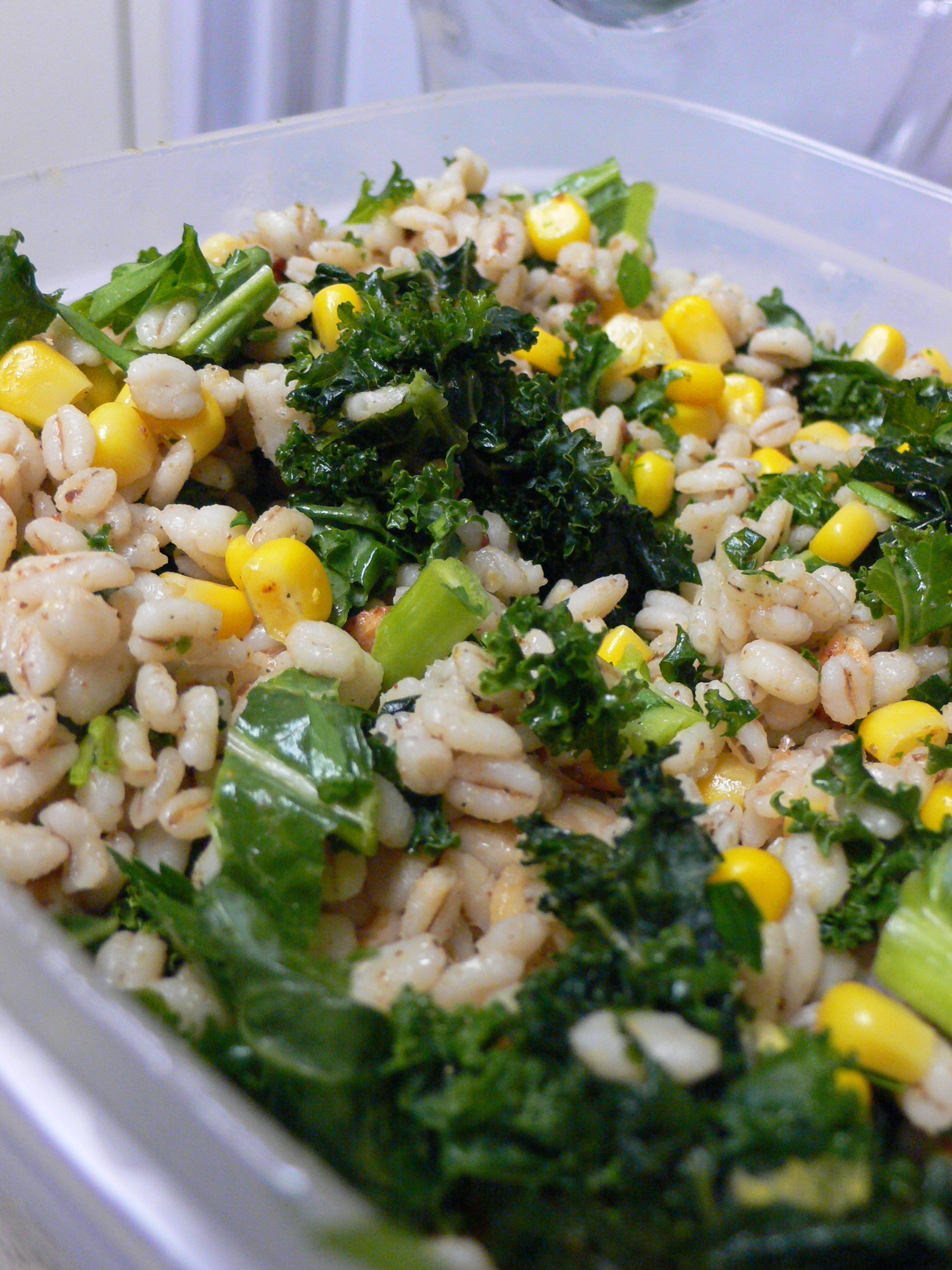
As I prepare for the big family camping trip to Burney Falls, I wanted to make a new salad – something the family hasn’t seen before and that satisfies the requirement of being summer-esque, full of veggies, and doesn’t taste too healthy. I piggy-backed off the concept of a quinoa salad I prepared last week for a bbq that was a HUGE hit and use barley and corn instead of quinoa and cucumber. In short: it ROCKS! Super easy, vegan, and prepped in no time at all!
“Summer in a bowl” Barley Salad
2 cups dried pearled barley (or quick barley from Quaker)
4 cups water or veggie broth
2 tsp each: salt, cumin, powdered onion, pepper, paprika, dried parsley
Cook barley with above spices and liquid as directed or in a rice cooker. Set aside and cool.
Meanwhile:
1 can organic corn OR kernels from 2-3 fresh cobbs, removed
½ large bunch kale, finely chopped
½ cup finely chopped parsley
2 tbsp EVOO
Juice of 1 lemon
1 tsp each: salt, paprika
Mix corn, parsley and kale together in a Tupperware. Add oil, lemon juice and spices. Close the lid and shake vigorously. Add to a large bowl, mixing in the cooked barley. Serve cold.
I think if I ever open a restaurant (Off-White Cafe anyone?), it would be a breakfast and lunch place. I enjoy making breakfast – maybe because morning is my favorite time of day. Also, for some reason the carbs I eat at breakfast don’t tend to cascade into over-snacking or carb cravings later that day. Hmm. So when our friend M. rolled into town and took us rock climbing yesterday, I felt that repaying him with cornmeal pancakes topped with yogurt, honey and banana was only fair. Sorry no pics ;(
PS: these are HEARTY!! 2 max per person is needed. Its about 2 hrs late and I still feel full. Good thing we are watching the Women’s World Cup before we head out for a bike ride!
Wheat-Free Cornmeal Pancakes (served 3 easily)
1 egg, separated
1 cups milk of your choice (in honor of our guest, who doesn’t do Almond Milk, I used Moo Juice)
Tbsp butter, melted
1/2 cup Spelt flour
1/2 teaspoon baking soda
1/2 teaspoon salt
1 teaspoon sugar
3/4 cups cornmeal, medium grain
1/4 cup of water – depending on consistency you like.
Beat egg white until stiff peaks form; set aside. Slightly beat the egg yolk in mixing bowl; blend in milk and butter. Mix together the flour, soda, salt, sugar, and cornmeal; blend into the liquid mixture until smooth. Fold in beaten egg white. Let batter stand for 10 minutes. Turn griddle or pan up to Med-high heat. Once warm, turn down to Medium (down a notch or so). Add a touch of butter to the pan for cooking. Pour about 1/4-1/2 cup of batter evenly onto skillet/griddle. Cook until the are consistent bubbles formed on the uncooked side. Flip and cook about 1 more minute. Both sides should be golden brown. These cook a little slower than pancakes. Serve with butter, plain yogurt, banana and a drizzle of honey. We also had a few crushed Pistachios to stick on top. Yum.
Serve with butter and warmed syrup. Also delicious with fried ham or bacon on the side.
Cornmeal pancake recipe serves 6 to 8.
my dang camera is out of juice and charging as we speak. I’m almost out of time and energy so I’m just going to post the recipe instead. My inspiration to film came from somebody who reminded me today how much I LOVE making videos, so I’m extra bummed that it didn’t work out, but oh well.
The true inspiration is really in the recipe. Recently a friend of mine made a tasty sweet potato and broccoli salad. While we chatted and sipped wine I sort of watched her put it together so I did my best to recreate the delectable dish. Best enjoyed with chicken or fish and good company. I love when sweet potatoes can replace grains on my plate. Not just because they are full of vitamin A and fiber, but because they are so preeetttyyyy…
Sweet Potato and Broccoli Salad
1 large sweet potato, cut into pieces 1/4″ thick and about 1″ in diameter
1 large bunch of broccoli, cut off all the crowns and then cut them into fork-size pieces
juice of 1 lemon
2 tbsp EVOO
sea salt, to taste
a mix of spices: I use 1 TBSP of Organic all purpose veggie spices from Costco, but you can pick what you like
Steam the sweet potato in a large pot. It will take about 20 minutes on a medium stovetop setting and you need to stir about every 4 minutes to evenly cook. Set aside in a large bowl. Meanwhile mix the EVOO, lemon, salt and spices to use as a marinade. While the sweet potato cools, steam the broccoli for about 5 minutes. Cool for 2-3 minutes. Add to the bowl. Pour the EVOO mix into the bowl and evenly coat all the veggies. Let it set for about an hour and then serve!
This post could also be entitled “I’d rather be eating Popsicles than standing over a hot stove”. It’s 90+ degrees here in the good ol’ central valley of California and I get a wild hare to make gluten-free crepes. Go figure. I did compromise and promise myself to cook the filling tomorrow as the sweat on my brow was telling me enough is enough.
Despite my heat-laden woes, I ended up with some pretty good savory crepes. These aren’t going to for breakfast, but rather for dinner tomorrow, stuffed with sauteed greens, shallots and maybe sweet potato-we’ll see how much face time I want to have with the hot stove when tomorrow’s weather hits.
In the meantime I highly recommend this recipe. When cooking these crepes you want to start by turning the burner on med-high to heat up the pan, and then turn down to medium for cooking. Don’t coat the pan with oil between every crepe, maybe every 3 or so. Also, flip them when the edges are turning up and there are little bubbles forming on top, but if you want too long you get sort of a crunchy crepe. If you don’t want enough time you get a broken crepe (I had a lot of these tonight because I was impatient!). Personally I like them a little crispy (golden brown and they crack when rolled) but they don’t fold up well. It’s up to you.
1 cup gluten-free flour (I used a rice flour)
2 eggs
1 cup almond milk
3 tbsp extra virgin oilve oil (I used a Spanish oil with a robust flavor – yum!)
1/2 cup water
2 tsp vegetable seasoning (it’s an organic blend from Costco, but you can mix up any you like)
pinch of salt
Put all ingredients in the blender and blend for about 30 seconds. Scrape down the sides and blend again. Let the batter set for as long as overnight but at least 30 minutes. I set mine in the fridge overnight.
You’ll have enough batter for about 10 8-9″ crepes. I make mine a little thicker (maybe about 1/8th inch?) than most, so if you spread the batter thin you’ll get more crepes. Fill them with whatever you like – sauteed veggies, a yogurt sauce, beans…sky is the limit!
PS: If you want to make these with me, come to the pancake cooking class at the Davis Food Coop on Wed, July 13th. Hand’s on experience with crepes, pancakes and fun ways to top ’em!
It was the best of meals…it was the worst of meals .
Last week the Federal Government debuted the new MyPlate as a replacement to MyPyramid, which was deemed confusing and irrelevant to most busy people who didn’t have time to decipher it. According to the first lady, “..This is a quick, simple reminder for all of us to be more mindful of the foods that we’re eating and as a mom, I can already tell how much this is going to help parents across the country…… ” As long as they’re half full (the plates) of fruits and vegetables, and paired with lean proteins, whole grains and low-fat dairy, we’re golden. That’s how easy it is.”
Hmm…is that so? I challenge that the new MyPlate, while being an improvement on MyPyramid, is still not going to be the Country’s solution to unhealthy eating.
Let’s examine two potential meals that would both technically fall into the parameters of the MyPlate program and see what meal is better nutritionally.
Meal 1: The budget-friendly, kid-friendly dinner
Vegetable: French Fries, cooked at home but from a frozen bag + 1 cup of “Iceberg Garden” salad from Fresh Express + 1 Tbsp of Hidden Valley Ranch Dressing
Fruit: Canned Peaches, in lite syrup
Protein: A breaded chicken breast, such as these boneless, breaded popcorn chicken bites by Tyson
Grain: 1 slice of Orowheat Honey Wheat Family bread with a small pat of butter
Dairy: Low-fat chocolate milk……it’s like having dessert with your dinner
Meal 2: A Foodie’s delight
Vegetable: Local, organic asparagus, sauteed in clarified butter, sprinkled with Parmesan cheese and slivered almonds
Fruit + Dairy: a sliced organic apples paired with an assortment of imported soft cheeses
Grain: 1 slice of whole grain Artesian French bread, with Olive oil and vinegar for dipping
Protein: Pine nut encrusted Halibut with roasted onions
Are these two meals really that different? I think the answer is “yes” and “no”.
First, how are they different. Obviously one is made of predominately processed foods, and likely contains a slough of food additives, nitrates and poor quality base ingredients. Can you guess which one?? Obvious, hopefully! Also, meal #2 includes organic items, thus is likely to include less pesticide than meal #1. The veggie in meal #1 isn’t likely to provide much in the way of nutritional value, and the bread probably doesn’t have a ton of whole grains. There is more sugar in meal #1, some of which comes from added sugars versus just the sugars naturally occurring in fruits. Also, in my opinion meal #2 seems a lot more delicious than meal #1, but of course I am biased since I made these two meals up. You can probably think of your own differences too.
But, how are they the same – that is what is really interesting to me!
I would argue that neither one are exceptionally nutritious without some downfalls. The downfalls in meal #1 seem obvious: processed food, lack of fiber, lack of “color”. But meal #2 has probably the same amount of fiber and has a lot more fat than #1. Yes, the fat may be from healthier (and more expensive) sources, but the caloric implications are not to be overlooked. Also, both contain significant sources of saturated fats. Both are heavy in animal products (by design, but this isn’t so uncommon for an American meal), and light in plant-based sources of nutrient dense food. They are also void of variety in the vegetables included. I’d argue that potatoes and onions have similar nutritional benefits (surprise, potatoes do have SOME nutritional value!), but of course asparagus, being ‘green’ and all, must have a lot more to offer than iceberg salad, right? Yes, from a vitamin perspective, but not enough to necessarily offset the high volume of animal fat sources, and just the overall fat content in that dish. I’d also argue that both meals contain a significant amount of sodium too. Both grain sources are more refined than whole, despite what might be stated on the front of the package or in their respective names., this is usually the case with bread.
Still, in all I’d rather have meal #2 from a taste AND nutrition perspective. And this is something that I would eat. However, the point I’m trying to make is that there is still a lot to be considered when following the new MyPlate approach to balanced eating. The nuances between types of protein, vegetables and grains can make significant differences in diet quality, weight and food behaviors. I don’t think the average person can necessarily accurately evaluate the overall pros/cons of their meal JUST based on the proportions of each food type or just based on the cost of ingredients or regionality of their food.
Also, are we talking about a 12″ plate, a 10″ plate, or a platter? This makes a HUGE difference in portion size!!
Oh, and my other ‘beef’ with this new system is the implication that we need to consume dairy at every meal. Thanks Dairy Council………
Here at Off White Living we anticipate your needs before you do. See, we knew that if you read the previous post you’d be asking for the Napoleon recipe, so here it is!
16 sheets of whole wheat (or regular) phyllo dough – PS: Whole wheat is hard to find, we have it at the Davis Coop!
8 oz whipping cream
8 oz ricotta cheese (or marscopone)
1 tsp lemon rind, grated
juice of 1/2 lemon
1.5 cup chopped strawberries
1 cup blueberries, chopped or whole
1/2 cup of a fine texture unrefined sugar (use a dry sugar)
1/2 cup butter, melted
Lay out 8 layers of phyllo dough on the counter or cutting board. Place them on a cookie sheet 2 at a time and baste them with butter and sprinkle with a bit of sugar. Layer the next 2 on top of it in the same way until you have 8. Cut them into 10 squares and gently separate. Bake for about 7 minutes at 350, but DON’T BURN!!
Repeat this process with the second set of 8 layers, so that in the end you have a set of ‘tops’ and a set of ‘bottoms’, each 8 layers thick. Set aside to cool.
Whip the whipping cream until stiff with the lemon juice, 1/2 of the remaining sugar and the lemon rind. Fold in the ricotta and remaining sugar. Mix on low until blended. Cool for 1 hour minimum.
In the meantime chop the berries but keep strawberries and blueberries separate.
To assemble: Lay out the 10 bottoms. Add 1 tbsp whip cream mix and spread. Sprinkle with a spoon of berries. Add a bit more whip cream mix and add a ‘top’. Add 1 tbsp of whip cream mix to the top and sprinkle with a mix of strawberries and blueberries. Serve immediately.
Option: make a balsamic reduction to sprinkle on top. Do this by boiling 1/2 cup blueberry balsamic vinegar for about 3 minutes. Reduce to a simmer and add 1/8 cup of sugar. Slowly simmer for about 20 minutes until syrupy. Chill for 1 hour before drizzling.
You will quickly find that the theme of this post is “waste not, want not”. It was a busy Saturday in the Tryon household. I was busy making whole wheat berry-lemon napoleons (that turned out great, by the way – see below!), when I had about 7 layers of phyllo dough left over. I just HATE letting good (and expensive) ingredients go to waste. So I put on my thinking cap, and go to it.
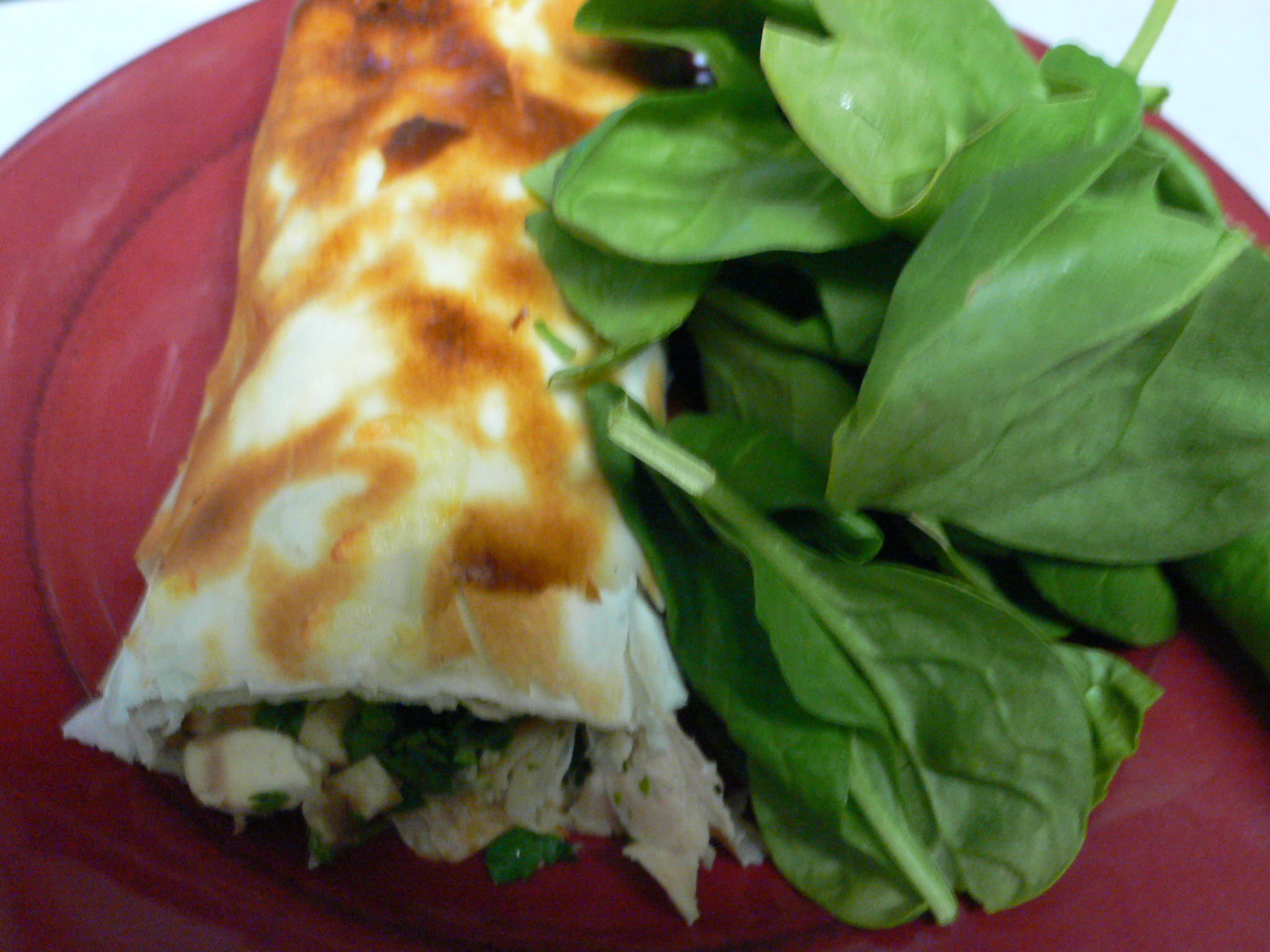
The resulting creating was a delicious, crispy yet light chicken and veggie burrito. I spread out my 7 layers of phyllo (still stacked). Next I took the left-over chicken from the previous night’s dinner and cut it into 1″ pieces and lay it length-wise along the midline of the phyllo. Then, thanks to the creativity of the huz, I added chopped green onions, mushrooms, and the left-over parsley from the week’s cooking class. Finally, a bit of pepper jack cheese and it was time to roll it up. I rolled so that it was like a long burrito and then lightly (and I do mean lightly) basted it with melted butter. To finish it off I dusted Matt’s end with some more pepper jack and placed it mid-over to bake for 6 minutes at 350. The secret to the success of this burrito was the 4 minutes of broiling to complete the masterpiece.
So, in less than 15 minutes I had a hot lunch, with some fiber, green veggies, healthy chicken protein and a splash of flavor with the cheese. Phyllo dough is very light relative to bread, thus overall grains and carbohydrate calories in 7 layers (split in 2, as I did share with the hubby!), is very little, yet the whole meal felt filling and satisfying. Not to mention the internal satisfaction I get from being resourceful.
I purchased a phyllo dough 2-pack for about $4.00 and this provided me enough phyllo for two sets of the Napoleons for social events (pic below, I PROMISE) and the burrito….and a bit for tasting, of course!
I remember a dumb diet cartoon that went around when I was a kid. It was two overweight people talking and one says “I”m on the see-food (spelled seafood) diet…. I SEE FOOD and I eat it!” Ha!
Well, maybe that isn’t so dumb after all. After reading a recent article in the Newsletter Nutrition Action, I was really inspired by the work of Dr. Brian Wasnik.I’ve seen him talk at the Experimental Biology conference in 2010 and recall his enthusiasm for understanding people’s eating behaviors. He gets beyond simply looking at food from a calories in/calories out perspective.
In a nutshell, his philosphy is that mindful eating is really about the food environment: how big is your plate? How fast are others eating their food around you? What cues do you use to know that you are full? Many of us DON’T use internal cues – we instead belong to the ‘clean plate club’ or stop eating when those around us do so. Have you ever noticed that about yourself? I certainly have! I’ve also noticed how food behaviors, like eating really fast, stick around with me even when the need to do so is absent. For instance, if I have plenty of time for a relaxed lunch, I’m more apt to still eat quickly if I’m eating alone because of the many days of my life when I was rushed (real or percieved) to do so. The result: I feel like I ‘missed something’ and usually want a sweet taste, even if it’s fruit, to end the meal.
In general, this work is really important if you are trying to change your behaviors. You could have the strongest desire to improve your diet and great intentions, but if you aren’t attuned to the visual, sensory, olfactory envrionment in which you eat, your best efforts may be no match for the subconscious influences.
I love the notion of eating food on nice dishes, instead of cheap, ugly/plastic/paper dishes. It speaks to the value of food as being worthy of attention. I love the idea that food presentation can help curb serving size. I’m much more likely to stop eating when full when the food is nicely presented because it’ a feast for the eyes as well as the body.
Look around your life and observe times when you over eat or eat things you don’t want to be consuming. What triggers it? Maybe the trigger isn’t even immediately felt? There have been times when I’ve watched some of those cooking shows about cupcakes (why so many cupcake shows??) and suddenly I can’t get cake and cupcakes out of my mind. I don’t watch those particular shows now b/c they stick with me and it’s hard for me to stop the drive to eat sweets when I’ve been subconsciously primed!!
This approach to food behavior is invaluable for helping us make lasting dietary changes on a familial, community and cultural level. We cannot simply continue to produce dietary recommendations unless they encompass a behavioral component as well. If simply telling people how many fruits and vegetables to consume was enough, obesity and diabetes and eating disorders would not be as prevalent as they currently are. My hope is to advocate for behavioral change as a fundamental component of dietary change in my future professional work. While one one hand it may feel overwhelming to realize that knowledge about healthy food isn’t enough to combat the pitfalls of a poor diet, it is also exciting to realize that maybe the reasons some of us have struggled are less about facts and more about the non-nutrient elements of eating that come into play. To be sure, fatty and sugar food will ALWAYS be pleasurable and may in themselves pose a risk of overconsumption, but unless we look at environment as well it remains unknown how much of that drive can be shifted my making changes in the external landscape.
Okay, I’ll hop off of my soapbox now! I’m simply excited to see this work being published in a mainstream format (via the newsletter and Dr. Wasnik’s books), as it gives further clout to something I’ve seen to be true as well. Now, to the matter of HOW to change the food and eating environment……..and that is for another post! But, a few things you can do in the meantime, perhaps:
Eat on a smaller plate – try it ONCE..and then again…and then for a week – change doesn’t happen overnight
Keep the fruits out so they are ‘in sight’ and more likely to be eaten as a snack
Tuck treats away out of visual sight- INCLUDING THE CANDY BOWL AT WORK!!
Keep your home eating place clean and pleasant looking
Prep vegetables when you buy them so that they can be ready to eat and place them on the top shelf in the fridge. Use resealable clear containers so you can always SEE what you have available
Play nice music when you eat
Portion out things purchased in bulk, like chips/trail mix/nuts/dried fruit.
Chew your food; purposefully eat with a slow eater so you can experience what it’s like to SLOW DOWN……
As if the taste, mouthfeel and pure joy of eating dark cocoa (and dark chocolate if it’s unadulterated) wasn’t enough….now we can eat cocoa because it is high in potassium. In fact, it is the potassium content in cocoa powder that makes it bitter to the taste, so you may have to adapt your taste buds a bit to enjoy this.
American’s under consume potassium and over consume sodium, yet the balance of the two is really important for cardiovascular health. So do your heart a favor and get some dark cocoa! I bake with it all the time, as well as add it to oatmeal or make hot chocolate with almond milk.
This article has more info on foods which are high in potassium.




 Off White Living