On resiliancy

Last week I participated in the UC Davis Entrepreneur Academy.  In a word: FANTASTIC!  One of the many benefits it gave me was a clear awareness that I want to have a successful career in health coaching and create coaching-based solutions for health and wellness challenges.

But, that isn’t what this post is about.  However, reigniting my fire for coaching led me to peruse some of the coaching literature I’d been neglecting since starting grad school.
I was reminded of the many benefits of coaching and all the great techniques and tools.  One concept specifically stood out to me: RESILIANCY.

To be resilient, in my book, is to be able to weather the storms of life while still keeping your head and heart rooted in your values and your wellbeing.  Resiliency was not a skill I developed as a young child.  It just wasn’t a trait my parents exemplified, as they were not very resilient themselves.  I believe much of my emotional sugar eating was born out of this lack of resilience.  I grew up having fear of everything I couldn’t control (which is everything) and thus turned to easy distractions to soothe my discomfort.  Candy.  Ice Cream.  Homemade cookies.  I think it’s no coincidence that sweet baked goods were my go-to binge food, as they represented a home-like comfort that I was seeking within myself and  couldn’t find.

In the past year I’ve been working hard at becoming more resilient.  I had no idea what this would look like 1 year ago but here is what it looks like today.  It means that when something changes suddenly in my life, I don’t have to ‘react’.  I can evaluate what is going on and I can ask questions.  I don’t say ‘yes’ as much as I used to, and when I start saying yest right away to every request guess what….I start wanting and eating sugar.    When my husband and I have a fight I don’t immediately force a solution (which never worked).  I can let things settle.  I guess you can say that I’m getting more comfortable with being uncomfortable.  I can hang in the tough emotional spaces a bit longer than I could before.

It has been amazing to me to see what cultivating emotional resilience has done.  I’m not hardened and cold – quite the opposite.  I’m more loving, compassionate and easy going (ask my husband!).  I don’t try and manipulate the environment to create an outcome I’m comfortable with.  I find myself saying “hmm…we’ll see what happens” or ‘I don’t have an answer to that problem yet but I’m open to finding a solution’.  These are new phrases for me.

A lot of women I’ve worked with as a coach also struggle with resiliency.  It’s scary to feel uncomfortable, unloved, confused, stressed, dismissed, angry and all the other myriad of unpleasantries that live brings us.  Sugar is a very seductive yet ineffective coping tool.  It never works for more than 10 minutes, does it?  While I don’t have a magic answer as to how resiliency begins, I can say that two things helped me:  journaling, journaling, journaling!!  Professional help, professional help, professional help!!  You are worth the time and resources it takes for both if this is an area of life you struggle with.

By no means am I suddenly the most resilient well-adapted human around.  Ha!  Don’t I wish.  But the fact that I’m aware of what it feels like when I lose my center and want to break instead of bend to the pressures of life is a HUGE improvement…and my sugar consumption has improved along with it!

Caught eating too much sugar…and how to avoid it

Really, do we need to go over this again? Yes.  We do.  Added sugar is still sneaking in everywhere and it’s time to revisit (or visit for the first time) some of the sneaky places sugar hides out.  I’m just going to go with what I’ve noticed in my diet and my shopping adventures lately.

Applesauce
Recently I mindlessly grabbed the first applesauce I saw and thought it was the brand I usually use.  Well, it was but it’s wasn’t the “No added sugar” version.  The result: The version I bought had 100 calories/half cup serving (my normal one only has 50) and it had 19g of sugar per serving. YIKES!  You don’t need to add sugar to an already sweet fruit like apples.  I use applesauce to bake with, to top oatmeal and yogurt and in smoothies.  Since I hate throwing things away I’ve been using it sparingly to bake with or to replace any honey that I might add to oats/yogurt.

Frozen Entrees
Yes, I admit that from time to time I turn to frozen entrees to grab a bite.  Usually I’m satisfied by looking at the front label to get my nutrition needs met, thinking that I’m smart enough to know when I might see something high in sugar.  Nope.  Recently I purchased a Lean Cuisine that had 23GRAMS OF SUGAR!!!  I forget what it was, but I was so frustrated.  Why is there that much sugar in a savory chicken/veggie dish?  And no, it wasn’t sweet and sour chicken.  Yuck.

Organic Cereals, hot or cold
God bless “organic”, but unfortunately it is sometimes translated into “Free Pass” to assume it’s the superior choice.  ORGANIC SUGAR IS STILL SUGAR AND METABOLIZED AS SUCH!   The organic frosted-mini-wheat style cereal I saw the other day (cleverly packaged in it’s ‘low impact’ packaging) had 17g sugar per 3/4 cup serving.  I’ve seen some organic flavored oatmeals that follow the same vein.  Look on the back and be savvy!!

Flavored beverages, especially those that will ‘refuel or energize’ you
Expensive and gimmicky, these beverages (like Gluekoes (sp??)) are much higher in sugar than the average weekend warrior needs.  Just drink water.  Hansen’s natural soda is the same.  Sugar is natural, but not necessarily healthy.  There are tons of other drinks out there that I don’t even know about, but again – look at the container.  If it’s got more than 10g of sugar/serving that is A LOT.  By comparison water (also known as skinny water these days??) has ZERO GRAMS OF SUGAR!!

Trail Mix

Question: What is the difference bewteen a Reese’s PB cup and a chocolate  candy and peanut trail mix?  Answer – not much really.  So, don’t be fooled.  Look at the label and see how much sugar is in a tiny 1/4 cup serving (not to mention fat and overall calories).  Unless you’re backpacking the John Muir trail those mixes may not be a good idea unless you treat them like a dessert.


Okay, that is my two cents on the matter these days – I’d love to hear yours!

As prompted by WordPress: Family Dinners

When I published the last post WordPress, in all of its cleverness, promoted me to think about posting on a few topics.  Family dinners was one of them, and being in a writing sort of mood I took the bait.

This may be of no interest to anybody but me, but oh well!  I think instead of posting about dinners at my house with Matt, I’ll post about the real ‘family dinners’, which involve nothing short of a 3-ring circus of events.

So here’s the low down.  I have dinner with my family of origin about every month or so, always at my Mom and Dad’s place in Grass Valley.  In summer these are eaten outdoors, and in the winter at the trusty kitchen table that my mom purchased from my 5th grade teacher oh so long ago (it’s an antique – about 150 yrs old, no kidding!).  No matter the venue and no matter how old I am they go a little something like this:

They are usually on a Sunday, about 5pm.  They start out intending to be about 4pm, so that is when I mentally plan to be ready, but like most things in the family, the don’t go off on time.
They almost always involved bbqing some kind of meat – I can’t remember a vegetarian dinner of this nature yet.  Tri-tip, Salmon, Chicken breasts and Tenderloin are favorites.
Given that my little sis lives just next door, her and my nephew are players at the table as well.  There is usually a lot of going back and forth between their two houses as we prep for the meal.  This is facilitated by my nephew who runs like the wind yelling about orders from one house to the other like the town crier.
I always seem to get roped into setting the table, and helping with clean up while my sister gets off scott-free from all these duties.  Of late she’s offered to help, which I think sent the universe off it’s axis (my sis is great, but not so much in the kitchen clean up arena).
We always have a large garden salad (if sis contributes anything it’s the salad, but typically I have to actually put it together, but not always).  There is usually 2 types of side dishes, which I am now allowed to contribute to.  I’ve yet to be allowed to provide the meat.  Once a parent, always a parent I suppose.
Once the food is set, and we are all seated in our typical configuration the circus begins.  It’s a mix of clanging glasses and forks, requests for passing this or that, and my mom harping on my dad about taking too big of bites or food on his moustache or chin (Dad had a stroke some years back and has trouble with fork-eye coordination at times).
Mom usually sits down last and is getting up constantly to get things for us, despite our pleas that we can, in fact, get up ourselves to get the mustard or whatever.
I often take seconds of everything but the meat.  Dad always takes seconds of the meat.   We are lucky if my nephew eats anything (it’s all ‘dirty’ if it’s not chicken nuggets, but that too is evolving), and my sister will eat anything she thinks has been cooked without added fats or sugars.  Matt and my sis’s boyfriend gratefully eat a balanced meal of all the options.
Conversation is usually light and centered a lot around getting my nephew to settle down and we NEVER bring up politics, for fear of sending dad into a tirade that goes off like a cannon if we are not careful.  There are awkward undertones to some extent, but in general its pleasant.  Matt is lucky to get a word in edgewise and it’s sometimes hard to keep up with the ever-shifting topics.

After dinner we clear plates and mom insists…really insists, on cleaning everything RIGHT THEN AND THERE – throwback from her days of serious cleaning OCD.  Dad asks for dessert about 3.2 seconds after his plate has left the table.  The reason is two fold: first, he knows she made something a-mazing like homemade lemon cheesecake or Magnolia pie.  Second, he (like me) really values the dessert portion of the meal far more than the meal itself.  Why eat at all if not to earn your dessert?
Reluctantly we bring out dessert and serve it up do Dad.  I nibble at it while I dish it out, constantly debating whether or not to actually have a formal piece of whatever it is or just nibble and pretend I didn’t have any.  The former usually wins out as my strategy.  Nobody else has dessert right then, but a few of us may linger at the table a little longer, helping ourselves to a second glass of wine, water, or maybe even some hot tea.
I help mom in the kitchen, Matt tries to help put things away to no avail because mom has her system and by God, you better not mess with it.  There is joking and banter about how we ‘break all the rules’ of clean up when we come over.
I usually walk away feeling like I’m 12 again, despite the fact that I’m celebrating my 35th birthday next month.
In short, it’s a full catastrophe and I wouldn’t miss any of them for the world!

Okay, your turn – what are your family dinners like?

Life on an $80/week grocery budget: How we do it

A long time ago I posted about buying groceries for $100.  Good stuff.  But since then out lives have changed.  Dramatically.  We are now both grad students with a very unforgiving grocery budget.  So, what does one do when the budget is tight and the expectations are high.  Here is how we eat well, mostly wheat-free, and very flavorfully for $82/week no matter what (and sometimes even less).


  • Look at the sale ads.  Before I even set foot in a grocery store I look at the sale ad for 3 stores:  Safeway, Nugget Market, and Savemart.   I usually choose 1-2 of these stores/week to go to based on what I need most and what has the most sale items of things we use.
  • Buy foods in bulk.  I do most of this at the Davis Food Coop and the foods I get include:
    • Oat bran
    • Oatmeal
    • Spelt, Oat, Rye and even Whole Wheat (sometimes) flour
    • Cocoa powder
    • All spices in bulk
    • Sea Salt
    • Unrefined sugar, as needed
    • Honey
    • Peanut Butter (sometimes)
    • Popcorn (unpopped, so I can cook it on the stove)
    • Gluten-free/Wheat-free pasta
  • Be willing to freeze things that are on sale for future use.  I do this mostly for:
    • Flaxmeal (recently got 1lb bags of organic Spectrum Flaxmeal for $.91/each – I bought 3 and freeze them)
    • All meats
    • Seasonal fruit like peaches and berries
    • Tomatoes (either frozen as puree or sauces)
    • Bread (when I buy it we freeze it and just take out 1-2 slices as needed, this is especially true of sprouted grain breads, which I only buy on sale)
  • Shop local fruit stands (I go to the Yolo Fruit stand bimonthly).   Seasonal, local and perhaps even organic produces is inexpensive there
  • CLip coupons.  It’s not always fun, but save 2-5$/week with coupons. Things I never buy without a coupon or on sale are;
    • Almond milk ( I refuse to pay more than $3/half gallon).  Coupons are plentiful in the paper or even at the store
    • Any boxed good like granola bars or FiberOne bars, which I buy when I have a coupon
    • Paper towels and TP (BTW this stuff fits into our $82/week budget)
    • Hair coloring (this is not from grocery budget but I buy it about every 6 weeks so it’s worth mentioning since the good stuff is spendy)
  • Don’t buy all the expensive stuff at once.  For instance I buy extra virgin olive oil about once/month or 6 weeks.  I even get Organic stuff for about $8-9/liter sometimes if I look at the ads or go to the Grocery Outlet.  Same goes for meats.  I buy organic beef about 1x/month because it’s expensive and then we have it for 2 meals/month.  Look at your most expensive items and see how you can spread the cost around.
    • On this note, don’t pass up a smokin’ deal of something you need but is pricey.  I don’t always wait until I really ‘need’ certain things to buy them.  Instead I buy when they are a really good deal so it’s already in stock
  • Avoid last minute ‘have to’ purchases.  THings like eggs, cheese, and even certain vegetables can be very expensive if you buy them last minute and they aren’t on sale.  I grocery shop 1 day/week so we don’t run out of things and have to make quick (and expensive) trips to the store.
  • Live without some things.  I don’t buy nearly as many Gluten-free products because of price.  I also buy my whole grains in bulk more often than in a package due to price.  Premade desserts, alcohol, and out of season/sale fruits and veggies aren’t an option any more.   Same goes for nuts, trail mixes, or frozen entrees (which I didn’t eat a lot of but sometimes for lunch at work).   We have a flexible list of the things we eat regularly  and sometimes we substitute our first preference for something else.  For instance, when mixed greens are on sale, we eat them as our bulk green for the week.  If next week it’s spinach and not mixed greens – we have spinach all week.  Same goes for the type of cheese and yogurt we consume (which we do in small quantities anyway) and even meats.
    • This means a lot more meal planning, using recipes, and thinking about how foods are going to pair together in meals when I’m shopping.  It’s like mixing and matching your wardrobe…only for your stomach!
  • Look at your beverage spending habits.  Coffee, flavored waters, teas, juice – all of that can add up.  Water should be the basis of your beverage diet.  Sometimes we buy flavored bubbly water and it can get pricey if we rely too much on them.  We also don’t go to the store mid-week and get more.  Whatever we have, that is what we eat.
  • Don’t be wasteful.  It should go without saying, but I used to throw away a lot more food than I do now.  I also don’t overbuy.  When I hit the stores every Sunday it’s because I need to go; we are running out of food!

I hope this may help some of you.  I love grocery shopping and figuring out how to get our needs/wants met without breaking the bank.  It’s like a puzzle for me.  I’d also love to hear any of your tips, faithful readers.

Inspiration from a good friend and fantastic food

no white flour/sugar in this tasty meal!

What a delight my day was.  Sharing a delicious, Off-White friendly meal with a dear friend and her 7 month old baby.  It’s not that she necessarily tried to do Off-White per se, it’s just that she’s a healthy cook with a creative flair and look what I got to enjoy as a result.  Both recipes are insiprations from the Food Networks success Giadia, but with some lighter twists.  We had an artichoke dish with spices, Parmersan cheese and a little olive oil, and an amazing tomato soup with lemon zest.  Fantastico!

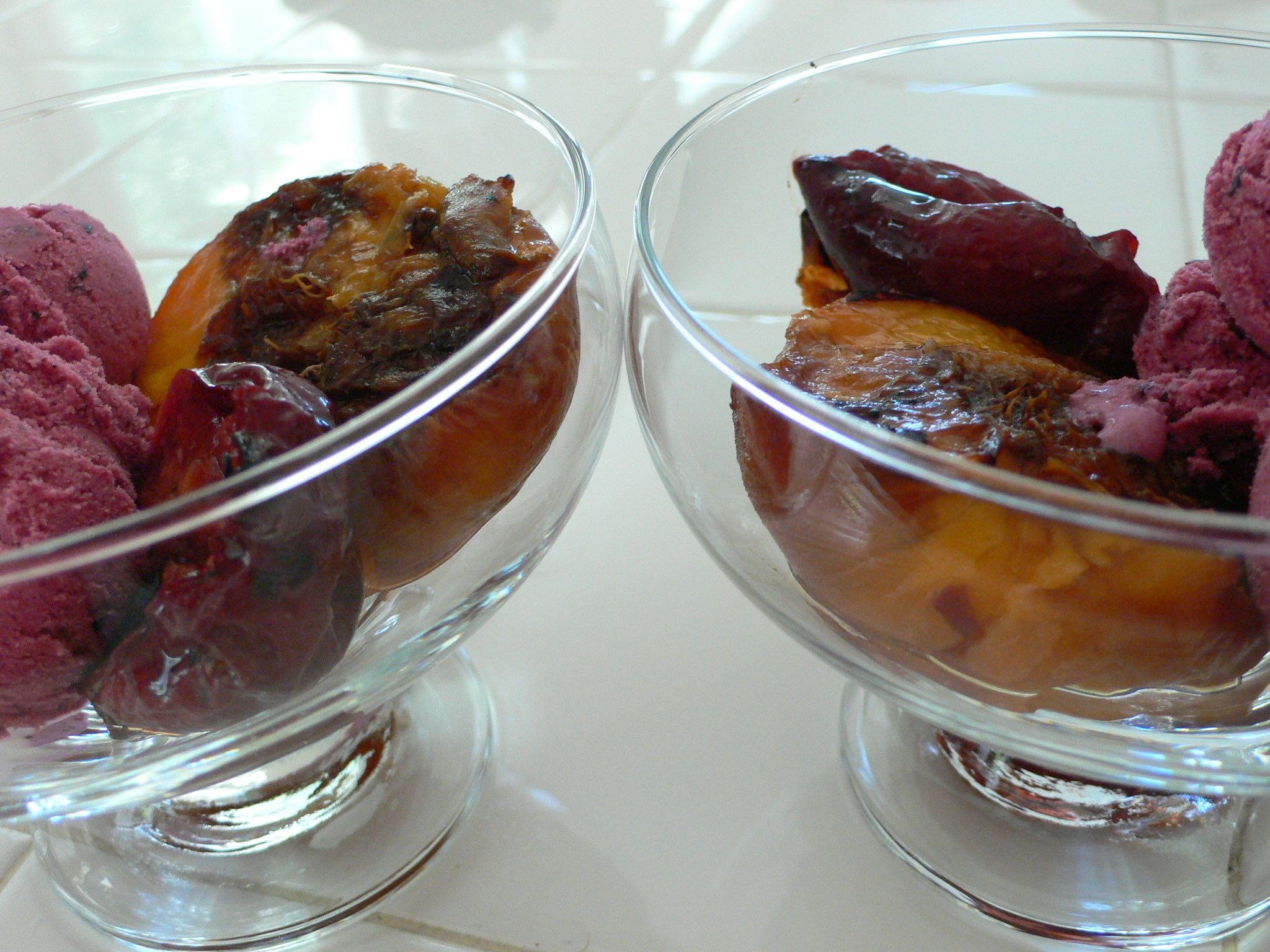
The palate pleasure did not stop there.  No Ma’am.  She topped it off with HOMEMADE berry frozen yogurt and grilled peaches.  And she had the nerve to say that she doesn’t know how busy mom’s have time to cook amazing food and blog about it. As far as I saw, she was 90% there (no blog..YET!)

divine on a hot day in Sacramento!

I guess what I loved the most about day with this dear friend was that she inspired me to get more creative with my cooking.  I’ve never made anything like what we had, and that was fantastic.  I loved the joy I felt when the soup hit my tongue and I sense sweet, sour, spicy and cool flavors all at the same time.  I loved the way the artichokes smelled coming out of the oven and the fact that she even pulled out the cloth place mats to complete our meal.  It was awesome to see her whip out a frozen tub of homemade berry yogurt.  It had that texture which brought me back to childhood when my mom used to make peach ice cream.  Nothing, I mean nothing, is like homemade creameries.
So, now I’m cooking up ideas.  What do I want to make?  There is a challenge going on at the Coop right now where we can enter pics of food made with local ingredients to win tix to a foodie event.  I’m SOO there.  But what to cook?  I tried some carrot muffins but…err…that didn’t turn out so well.  So it’s back to the drawing board but now I have some new inspiration.


A tale of two plates

New Plate symbol replaces the Pyramid

It was the best of meals…it was the worst of meals .

Last week the Federal Government debuted the new MyPlate as a replacement to MyPyramid, which was deemed confusing and irrelevant to most busy people who didn’t have time to decipher it.  According to the first lady, “..This is a quick, simple reminder for all of us to be more mindful of the foods that we’re eating and as a mom, I can already tell how much this is going to help parents across the country…… ” As long as they’re half full (the plates) of fruits and vegetables, and paired with lean proteins, whole grains and low-fat dairy, we’re golden. That’s how easy it is.”

Hmm…is that so?  I challenge that the new MyPlate, while being an improvement on MyPyramid, is still not going to be the Country’s solution to unhealthy eating.

Let’s examine two potential meals that would both technically fall into the parameters of the MyPlate program and see what meal is better nutritionally.

Meal 1:  The budget-friendly, kid-friendly dinner
Vegetable: French Fries, cooked at home but from a frozen bag + 1 cup of “Iceberg Garden” salad from Fresh Express + 1 Tbsp of Hidden Valley Ranch Dressing
Fruit: Canned Peaches, in lite syrup
Protein:  A breaded chicken breast, such as these boneless, breaded popcorn chicken bites by Tyson
Grain:  1 slice of Orowheat Honey Wheat Family  bread with a small pat of butter
Dairy:  Low-fat chocolate milk……it’s like having dessert with your dinner

Meal 2: A Foodie’s delight
Vegetable:  Local, organic asparagus, sauteed in clarified butter, sprinkled with Parmesan cheese and slivered almonds
Fruit + Dairy: a sliced  organic apples paired with an assortment of imported soft cheeses
Grain:  1 slice of  whole grain Artesian French bread, with Olive oil and vinegar for dipping
Protein:  Pine nut encrusted Halibut with roasted onions

Are these two meals really that different?  I think the answer is “yes” and “no”.
First, how are they different.  Obviously one is made of predominately processed foods, and likely contains a slough of food additives, nitrates and poor quality base ingredients.  Can you guess which one?? Obvious, hopefully!  Also, meal #2 includes organic items, thus is likely to include less pesticide than meal #1.  The veggie in meal #1 isn’t likely to provide much in the way of nutritional value, and the bread probably doesn’t have a ton of whole grains.   There is more sugar in meal #1, some of which comes from added sugars versus just the sugars naturally occurring in fruits.  Also, in my opinion meal #2 seems a lot more delicious than meal #1, but of course I am biased since I made these two meals up.  You can probably think of your own differences too.

But, how are they the same – that is what is really interesting to me!
I would argue that neither one are exceptionally nutritious without some downfalls.  The downfalls in meal #1 seem obvious: processed food, lack of fiber, lack of “color”.  But meal #2 has probably the same amount of fiber and has a lot more fat than #1.  Yes, the fat may be from healthier (and more expensive) sources, but the caloric implications are not to be overlooked.  Also, both contain significant sources of saturated fats.   Both are heavy in animal products (by design, but this isn’t so uncommon for an American meal), and light in plant-based sources of nutrient dense food.  They are also void of variety in the vegetables included.  I’d argue that potatoes and onions have similar nutritional benefits (surprise, potatoes do have SOME nutritional value!), but of course asparagus, being ‘green’ and all, must have a lot more to offer than iceberg salad, right?  Yes, from a vitamin perspective, but not enough to necessarily offset the high volume of animal fat sources, and just the overall fat content in that dish.  I’d also argue that both meals contain a significant amount of sodium too.  Both grain sources are more refined than whole, despite what might be stated on the front of the package or in their respective names., this is usually the case with bread.

Still, in all I’d rather have meal #2 from a taste AND nutrition perspective.  And this is something that I would eat.  However, the point I’m trying to make is that there is still a lot to be considered when following the new MyPlate approach to balanced eating.  The nuances between types of protein, vegetables and grains can make significant differences in diet quality, weight and food behaviors.   I don’t think the average person can necessarily accurately evaluate the overall pros/cons of their meal JUST based on the proportions of each food type or just based on the cost of ingredients or regionality of their food.

Also, are we talking about a 12″ plate, a 10″ plate, or a platter?  This makes a HUGE difference in portion size!!
Oh, and my other ‘beef’ with this new system is the implication that we need to consume dairy at every meal.  Thanks Dairy Council………

a new fast food “phyllo”-sophy

a quick lunch made from left-overs

You will quickly find that the theme of this post is “waste not, want not”.  It was a busy Saturday in the Tryon household.  I was busy making whole wheat berry-lemon napoleons (that turned out great, by the way – see below!), when I had about 7 layers of phyllo dough left over.  I just HATE letting good (and expensive) ingredients go to waste.  So I put on my thinking cap, and go to it.

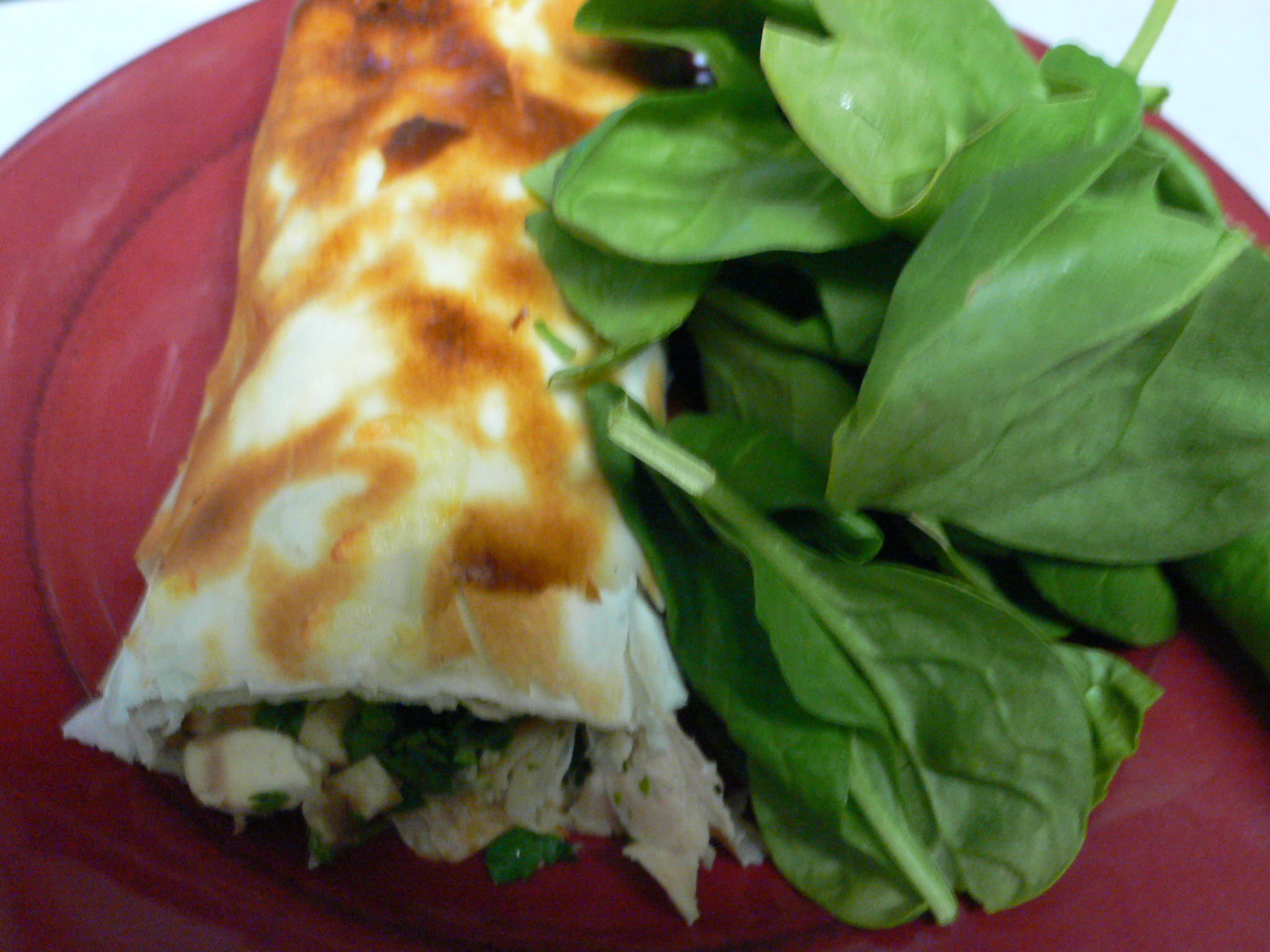
The resulting creating was a delicious, crispy yet light chicken and veggie burrito.    I  spread out my 7 layers of phyllo (still stacked).  Next I took the left-over chicken from the previous night’s dinner and cut it into 1″ pieces and lay it length-wise along the midline of the phyllo.  Then, thanks to the creativity of the huz, I added chopped green onions, mushrooms, and the left-over parsley from the week’s cooking class.  Finally, a bit of pepper jack cheese and it was time to roll it up.  I rolled so that it was like a long burrito and then lightly (and I do mean lightly) basted it with melted butter.    To finish it off I dusted Matt’s end with some more pepper jack and placed it mid-over to bake for 6 minutes at 350.  The secret to the success of this burrito was the 4 minutes of broiling to complete the masterpiece.

So, in less than 15 minutes I had a hot lunch, with some fiber, green veggies, healthy chicken protein and a splash of flavor with the cheese.  Phyllo dough is very light relative to bread, thus overall grains and carbohydrate calories in 7 layers (split in 2, as I did share with the hubby!), is very little, yet the whole meal felt filling and satisfying.  Not to mention the internal satisfaction I get from being resourceful.

I purchased a phyllo dough 2-pack for about $4.00 and this provided me enough phyllo for two sets of the Napoleons  for social events (pic below, I PROMISE) and the burrito….and a bit for tasting, of course!

customize: half with cheese, half without!


And the picture you’ve really been waiting for….

(relatively) low sugar, lower fat berry-lemon napoleons

the “SEE FOOD” Diet

I remember a dumb diet cartoon that went around when I was a kid.  It was two overweight people talking and one says “I”m on the see-food (spelled seafood) diet…. I SEE FOOD and I eat it!”  Ha!

Well, maybe that isn’t so dumb after all.  After reading a recent article in the Newsletter Nutrition Action, I was really inspired by the work of Dr. Brian Wasnik.I’ve seen him talk at the Experimental Biology conference in 2010 and recall his enthusiasm for understanding people’s eating behaviors.  He gets beyond simply looking at food from a calories in/calories out perspective.

In a nutshell, his philosphy is that mindful eating is really about the food environment: how big is your plate?  How fast are others eating their food around you?  What cues do you use to know that you are full?  Many of us DON’T use internal cues – we instead belong to the ‘clean plate club’ or stop eating when those around us do so.  Have you ever noticed that about yourself?  I certainly have!   I’ve also noticed how food behaviors, like eating really fast, stick around with me even when the need to do so is absent.  For instance, if I have plenty of time for a relaxed lunch, I’m more apt to still eat quickly if I’m eating alone because of the many days of my life when I was rushed (real or percieved) to do so.  The result: I feel like I ‘missed something’ and usually want a sweet taste, even if it’s fruit, to end the meal.

In general, this work is really important if you are trying to change your behaviors.  You could have the strongest desire to improve your diet and great intentions, but if you aren’t attuned to the visual, sensory, olfactory envrionment in which you eat, your best efforts may be no match for the subconscious influences.

I love the notion of eating food on nice dishes, instead of cheap, ugly/plastic/paper dishes.  It speaks to the value of food as being worthy of attention.  I love the idea that food presentation can help curb serving size.  I’m much more likely to stop eating when full when the food is nicely presented because it’ a feast for the eyes as well as the body.

Look around your life and observe times when you over eat or eat things you don’t want to be consuming.  What triggers it?  Maybe the trigger isn’t even immediately felt?  There have been times when I’ve watched some of those cooking shows about cupcakes (why so many cupcake shows??) and suddenly I can’t get cake and cupcakes out of my mind.  I don’t watch those particular shows now b/c they stick with me and it’s hard for me to stop the drive to eat sweets when I’ve been subconsciously primed!!

This approach to food behavior is invaluable for helping us make lasting dietary changes on a familial, community and cultural level.  We cannot simply continue to produce dietary recommendations unless they encompass a behavioral component as well.  If simply telling people how many fruits and vegetables to consume was enough, obesity and diabetes and eating disorders would not be as prevalent as they currently are.  My hope is to advocate for behavioral change as a fundamental component of dietary change in my future professional work.  While one one hand it may feel overwhelming to realize that knowledge about healthy food isn’t enough to combat the pitfalls of a poor diet, it is also exciting to realize that maybe the reasons some of us have struggled are less about facts and more about the non-nutrient elements of eating that come into play.  To be sure, fatty and sugar food will ALWAYS be pleasurable and may in themselves pose a risk of overconsumption, but unless we look at environment as well it remains unknown how much of that drive can be shifted my making changes in the external landscape.

Okay, I’ll hop off of my soapbox now!  I’m simply excited to see this work being published in a mainstream format (via the newsletter and Dr. Wasnik’s books), as it gives further clout to something I’ve seen to be true as well.  Now, to the matter of HOW to change the food and eating environment……..and that is for another post!  But, a few things you can do in the meantime, perhaps:

  • Eat on a smaller plate – try it ONCE..and then again…and then for a week – change doesn’t happen overnight
  • Keep the fruits out so they are ‘in sight’ and more likely to be eaten as a snack
  • Tuck treats away out of visual sight- INCLUDING THE CANDY BOWL AT WORK!!
  • Keep your home eating place clean and pleasant looking
  • Prep vegetables when you buy them so that they can be ready to eat and place them on the top shelf in the fridge.  Use resealable clear containers so you can always SEE what you have available
  • Play nice music when you eat
  • Portion out things purchased in bulk, like chips/trail mix/nuts/dried fruit.
  • Chew your food; purposefully eat with a slow eater so you can experience what it’s like to SLOW DOWN……

Where have I been???

hi bloggies,

Yes, it has been a WHILE.  Waay to long, in fact.  Sorry.  I’ve been busy.  Real Busy.  This kind of busy that doesn’t always leave much room for reflecting on the internet.  I want to say to you that I’ll be better and get more consistent, but I’m not making any promises.  I just wanted you to know I’m still here fighting the good fight!  I’m filling my head with knowledge about nutrition, science, research, etc like you wouldn’t believe. ….and you know what it’s taught me about Off-White living??
Nothing.  Not a freakin’ thing….seriously.  I’m not begin cynical, as I’ve learned so much about other things, but Off-White Living isn’t really something I can learn by reading or memorizing metabolic pathways (though I think you might like the “cheat” way that we came up with to remember the steps in the TCA Cycle: “Officer Can I Keep Selling Sex For Money?”  Catchy, isn’t it”).  Off White living is a process to be lived and understood by each person who embarks on it.   That much I have learned by being in grad school.  Researchers are no closer to solving the obesity epidemic than they are from curing AIDS or colonizing Mars.  The epidemic is to be solved one person at a time but paradoxically requires the support and efforts of the entire community, I think, and that doesn’t work well in a research environment.

However, I’m still infatuated with the process of dietary change.  I still get delighted when I start chatting it up with somebody and the topic migrates over to food/nutrition and I hear that they have been changing their diet, and hence changing their lives.  Just last night when I was knee deep in teaching undergrads how to calibrate  their instruments to prepare for lab  I heard a gal say that she’s relinquished refined flour and her family is raising a stink about it.  Yay to her, I said and we talked about how emotionally charged food habits can be.  Her family called her an ‘extremist’ for such choices.  I call her a crusader!  I just wish I had more time to invest in the crusade on a larger scale than I currently do.  But for now, I’m walking my own line.   Recently Matt and I recommitted to the eating lifestyle we know serves us best, so that means breads and sweets are out (because BELIEVE ME, they were in like Flynn for a while).   Nothing fanatical, just listening to our own advise and it feels good to be back on the wagon.  We discovered this awesome rye bread from northern Europe that comes in a package which resembles a brick.  You only get about 7 slices, but 1/2 a slice is PLENTY.  This stuff is dense and delicious…and totally wheat free.  Yeah!  I love it when the food world continues to surprise me.  I don’t have the name of this bread but it’s found at Rite Aid and World Market.  Check it out.

Also, would somebody get on task of importing SKYR (a delicious low fat/high protein yogurt like substance) from Iceland to here?  Why do we NOT have that food?  Granted, it made my intestines very angry (too much Casein, which I cannot digest) but it’s delicious and would give the American People something healthy to swoon over.   Seriously.


No your mama’s breakfast sandwich

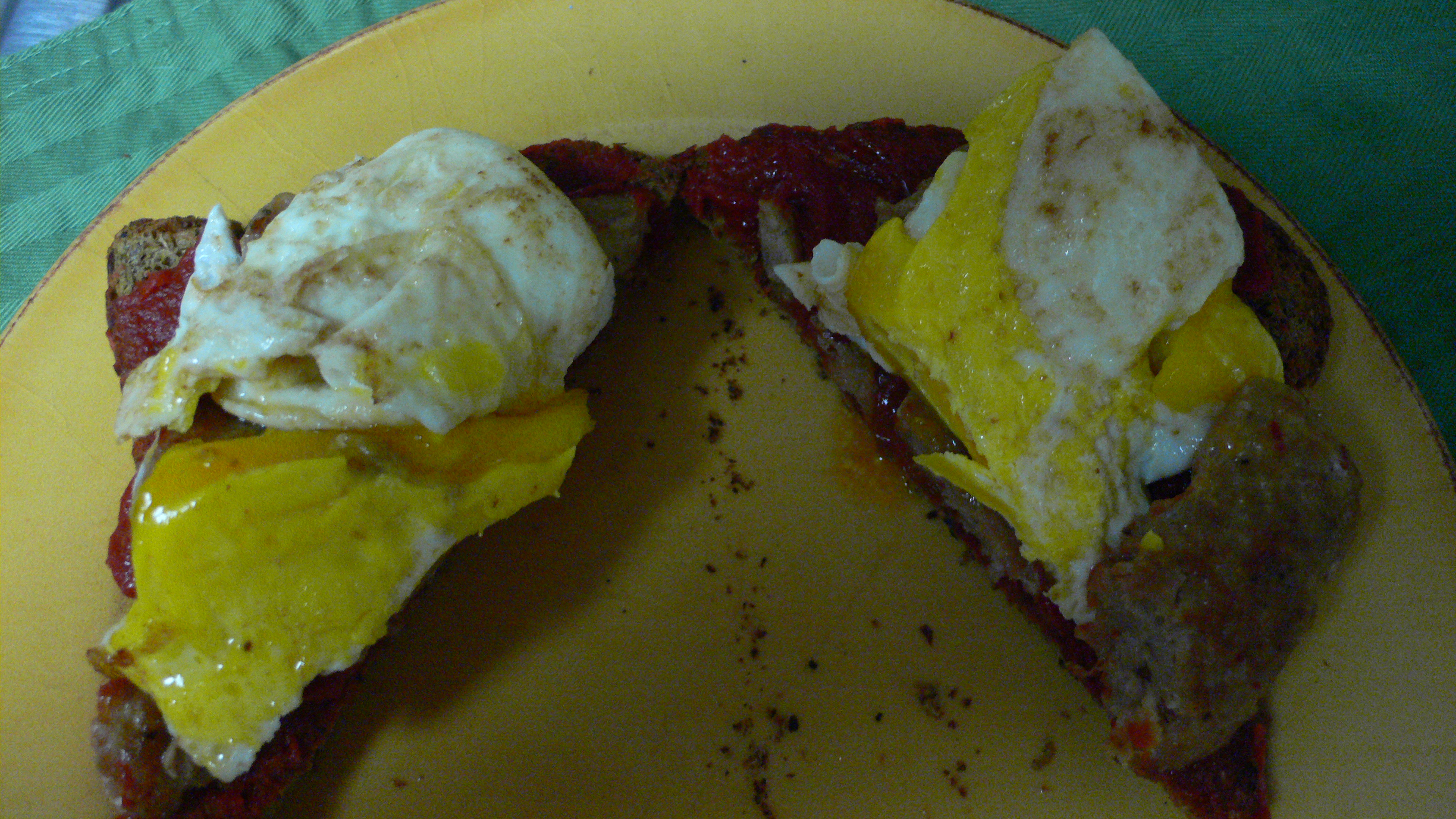
I can't believe I held out long enough to take a pic before I dived in!

Move over Jimmy Dean.  Step aside McDonald’s Egg McMuffin.  There is a NEW kid in town.

On occasion I sell by body to science. Well, not the whole thing – just my blood.  It’s a win-win.  I eat a fatty breakfast.  They take my blood to look at cholesterol and I get $20.  Everybody is happy!

The downside is the fatty breakfast.  I’m not opposed to fat, by any means.  But the first couple times I did the study I ate at ….um…I hate to say it: McDonalds.  It was nasty, just like I expected.  Something had to change if I was going to do this on a regular basis.

Being the lover of fiber and creative cook that I am, solutions unfolded right before my eyes.  Thanks to my new local Trader Joe’s, I concocted a more err, sophistocated breakfast sandwich.  It’s easy, filling, and oh yes, quite fatty 🙂

1 piece of sprouted rye bread, toasted (from TJ’s)
1 whole egg, cooked sunny side up (cooked in the fat of the sausage)
1 Chicken Sicilian Sausage link from TJ’s (Their brand).  Trust me, one is PLENTY.  These bad boys are big
1 tbsp tomato paste, spread on the toast.

YUM!