a new fast food “phyllo”-sophy

a quick lunch made from left-overs

You will quickly find that the theme of this post is “waste not, want not”.  It was a busy Saturday in the Tryon household.  I was busy making whole wheat berry-lemon napoleons (that turned out great, by the way – see below!), when I had about 7 layers of phyllo dough left over.  I just HATE letting good (and expensive) ingredients go to waste.  So I put on my thinking cap, and go to it.

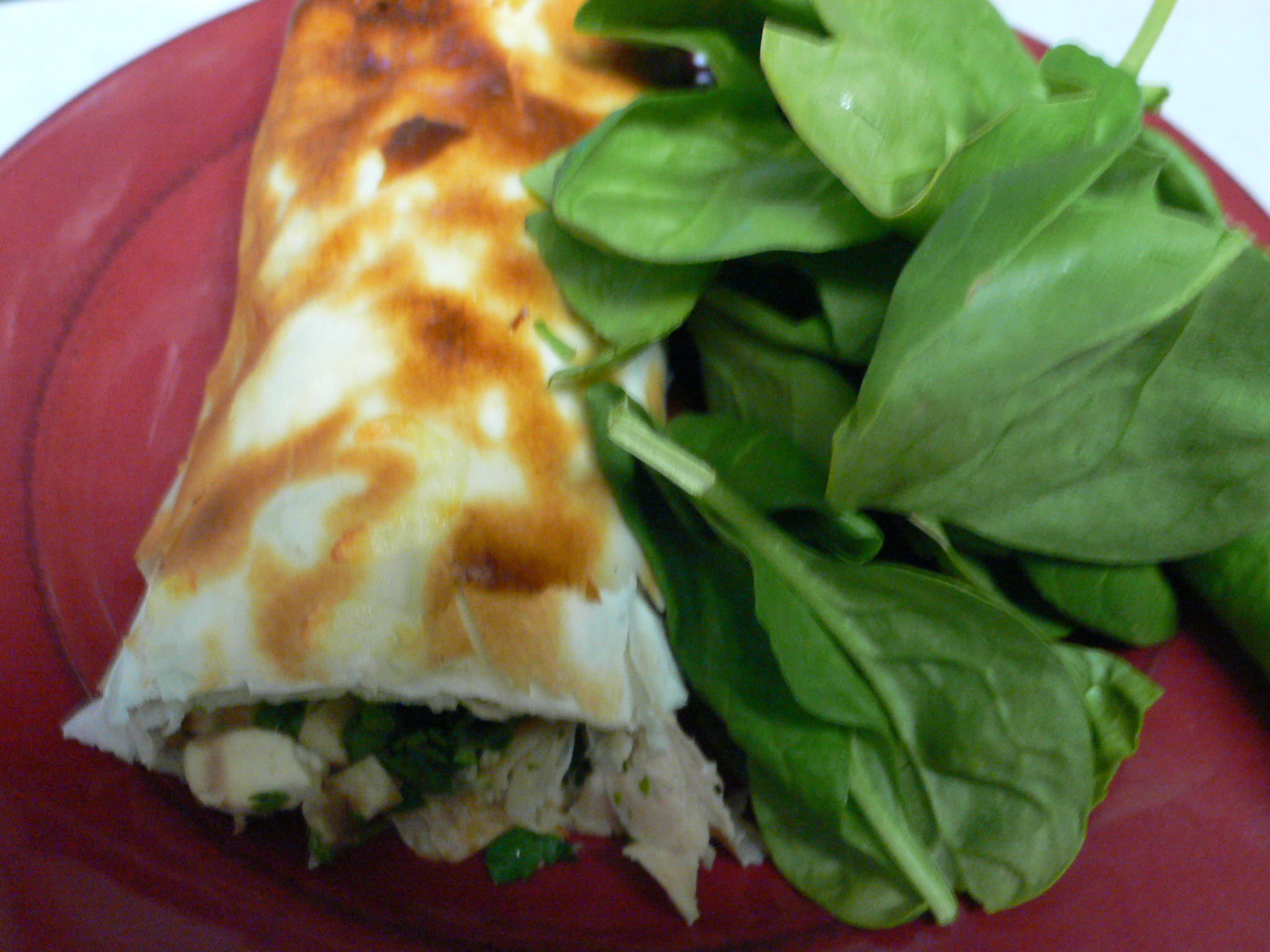
The resulting creating was a delicious, crispy yet light chicken and veggie burrito.    I  spread out my 7 layers of phyllo (still stacked).  Next I took the left-over chicken from the previous night’s dinner and cut it into 1″ pieces and lay it length-wise along the midline of the phyllo.  Then, thanks to the creativity of the huz, I added chopped green onions, mushrooms, and the left-over parsley from the week’s cooking class.  Finally, a bit of pepper jack cheese and it was time to roll it up.  I rolled so that it was like a long burrito and then lightly (and I do mean lightly) basted it with melted butter.    To finish it off I dusted Matt’s end with some more pepper jack and placed it mid-over to bake for 6 minutes at 350.  The secret to the success of this burrito was the 4 minutes of broiling to complete the masterpiece.

So, in less than 15 minutes I had a hot lunch, with some fiber, green veggies, healthy chicken protein and a splash of flavor with the cheese.  Phyllo dough is very light relative to bread, thus overall grains and carbohydrate calories in 7 layers (split in 2, as I did share with the hubby!), is very little, yet the whole meal felt filling and satisfying.  Not to mention the internal satisfaction I get from being resourceful.

I purchased a phyllo dough 2-pack for about $4.00 and this provided me enough phyllo for two sets of the Napoleons  for social events (pic below, I PROMISE) and the burrito….and a bit for tasting, of course!

customize: half with cheese, half without!


And the picture you’ve really been waiting for….

(relatively) low sugar, lower fat berry-lemon napoleons

the “SEE FOOD” Diet

I remember a dumb diet cartoon that went around when I was a kid.  It was two overweight people talking and one says “I”m on the see-food (spelled seafood) diet…. I SEE FOOD and I eat it!”  Ha!

Well, maybe that isn’t so dumb after all.  After reading a recent article in the Newsletter Nutrition Action, I was really inspired by the work of Dr. Brian Wasnik.I’ve seen him talk at the Experimental Biology conference in 2010 and recall his enthusiasm for understanding people’s eating behaviors.  He gets beyond simply looking at food from a calories in/calories out perspective.

In a nutshell, his philosphy is that mindful eating is really about the food environment: how big is your plate?  How fast are others eating their food around you?  What cues do you use to know that you are full?  Many of us DON’T use internal cues – we instead belong to the ‘clean plate club’ or stop eating when those around us do so.  Have you ever noticed that about yourself?  I certainly have!   I’ve also noticed how food behaviors, like eating really fast, stick around with me even when the need to do so is absent.  For instance, if I have plenty of time for a relaxed lunch, I’m more apt to still eat quickly if I’m eating alone because of the many days of my life when I was rushed (real or percieved) to do so.  The result: I feel like I ‘missed something’ and usually want a sweet taste, even if it’s fruit, to end the meal.

In general, this work is really important if you are trying to change your behaviors.  You could have the strongest desire to improve your diet and great intentions, but if you aren’t attuned to the visual, sensory, olfactory envrionment in which you eat, your best efforts may be no match for the subconscious influences.

I love the notion of eating food on nice dishes, instead of cheap, ugly/plastic/paper dishes.  It speaks to the value of food as being worthy of attention.  I love the idea that food presentation can help curb serving size.  I’m much more likely to stop eating when full when the food is nicely presented because it’ a feast for the eyes as well as the body.

Look around your life and observe times when you over eat or eat things you don’t want to be consuming.  What triggers it?  Maybe the trigger isn’t even immediately felt?  There have been times when I’ve watched some of those cooking shows about cupcakes (why so many cupcake shows??) and suddenly I can’t get cake and cupcakes out of my mind.  I don’t watch those particular shows now b/c they stick with me and it’s hard for me to stop the drive to eat sweets when I’ve been subconsciously primed!!

This approach to food behavior is invaluable for helping us make lasting dietary changes on a familial, community and cultural level.  We cannot simply continue to produce dietary recommendations unless they encompass a behavioral component as well.  If simply telling people how many fruits and vegetables to consume was enough, obesity and diabetes and eating disorders would not be as prevalent as they currently are.  My hope is to advocate for behavioral change as a fundamental component of dietary change in my future professional work.  While one one hand it may feel overwhelming to realize that knowledge about healthy food isn’t enough to combat the pitfalls of a poor diet, it is also exciting to realize that maybe the reasons some of us have struggled are less about facts and more about the non-nutrient elements of eating that come into play.  To be sure, fatty and sugar food will ALWAYS be pleasurable and may in themselves pose a risk of overconsumption, but unless we look at environment as well it remains unknown how much of that drive can be shifted my making changes in the external landscape.

Okay, I’ll hop off of my soapbox now!  I’m simply excited to see this work being published in a mainstream format (via the newsletter and Dr. Wasnik’s books), as it gives further clout to something I’ve seen to be true as well.  Now, to the matter of HOW to change the food and eating environment……..and that is for another post!  But, a few things you can do in the meantime, perhaps:

  • Eat on a smaller plate – try it ONCE..and then again…and then for a week – change doesn’t happen overnight
  • Keep the fruits out so they are ‘in sight’ and more likely to be eaten as a snack
  • Tuck treats away out of visual sight- INCLUDING THE CANDY BOWL AT WORK!!
  • Keep your home eating place clean and pleasant looking
  • Prep vegetables when you buy them so that they can be ready to eat and place them on the top shelf in the fridge.  Use resealable clear containers so you can always SEE what you have available
  • Play nice music when you eat
  • Portion out things purchased in bulk, like chips/trail mix/nuts/dried fruit.
  • Chew your food; purposefully eat with a slow eater so you can experience what it’s like to SLOW DOWN……
On Beginnings….

“The Miracle Was Not that I Finished, but That I Ever Began”.

I have no idea who originally said this, but I first came across this profound statement on the back of a runner’s tee-shirt at the Luna Bar Women’s Duathalon .  To me, this quote sums up all that I could really say for myself about starting the off-white process as well as all that really matters.

Often, after coming upon my blog or learning about my professional experiences, people ask me how they can get started, or rather, is it even possible for them to get started.  I can see the desperation in their eyes because they’ve probably tried everything: Weight Watchers, calorie counting, hypnosis, swearing off certain foods…whatever.  I can also see that desperation because I too have felt it.  I know that feeling of totally ‘blowing it’ by eating out of control or binging on sweets, and feeling like all the hard work you put into your dietary changes are gone.  Boom….go back to the beginning.  It’s even worse when that feeling of blowing it is followed by the nagging voice of “you should know better”.  Aaargh, who wouldn’t feel shame if the  harpies of “woulda, shoulda, coulda” were barking in your ear.

It has taken me a long time to work on that black and white mentality.  I always feel like if I’m not being perfect with something (Food, school, money, whatever), I’m therefore a total failure.  Not much wiggle room in that mindset.    This thinking has often overwhelmed me because it made me feel like none of my changes, insights or experiences counted for anything and I was back at square one.  How exhausting and defeating!  With the help of friends, therapists, journaling, and some down and out cry-fests, I’m evolving this attitude.  The miracle is that I even started this process in the first place and that I “woke up” to wanting a better life for myself.    It’s also a miracle that I don’t give up.  As my friend S. says… “Don’t give up because you are always just 3 feet from gold”.  Even if I ‘screw up’ (which I put in quotes because it’s not real, just my mind being in judgement)or make a choice that really isn’t the best for me, I’ve not destroyed the past.  I’m not back at the beginning.  I’m right where I was and I have something to learn from whatever is happening in the moment.

In some ways perhaps many of us will always be at the beginning, so we may as well get used to it.  That is a very yogic philosophy on this whole process, but I buy into it.

If you are at the beginning, meaning that you are now just realizing that you want to change your diet in whatever way and reestablish a healthy relationship with food then CELEBRATE that awareness!  It is the most important thing.  Trust your skills and assets to help you. The same innovative thinking that helps you juggle work/family/hobbies or unclog the sink or deal with a difficult coworker can all help you deal with your own food experiences.  You come to the table with a lot of assets.  Be be patient don’t expect yourself to change overnight…it will just set you up for disappointment and that feeling like you are back at the beginning.  Start with ONE manageable change.  If you used to eat two candy bars per day and now you eat one, you have made a change.  If you switched to water instead of soda – you are a rockstar.  If you started journaling your feelings and realized that there is an ocean of emotion in there – yes!!!  This is progress!!!

It has taken me YEARS to get to where I am now, which is nowhere close to perfect, but it’s better than it was the day before.  Each day that I appreciate the fact I even decided to begin this process of Off-White living, I am a grateful woman and more likely to stay on the horse as I journey down this path.

Hail to Kale


The beginnings of a spinach kale and veggie frittata

In preparation for my upcoming cooking class at the Davis Coop next Monday, I came upon this article about all the benefits of kale.

It got me thinking.  Why do we, as a culture, pay homage to junk like Gingerbread Latte’s, soda, overstuffed burritos and all that kind of food  when the payoff for eating things like kale and other greens is SO MUCH HIGHER!  Kale alone has been associated with reducing cancer risk (along with it’s cousin Brussel Sprouts), is high in beta-carotene, vitamin C, calcium and potassium and more.  Furthermore, and maybe most importantly for Off-White eaters, foods like kale with a bitter principle can help reduce carb cravings and promote optimal digestive movement.

If only the fruit and veggie industry had the marketing budget of McDonald’s or Dow chemical (who, but the way, also makes a lot of food products – hopefully not at the same place that make your scrubbing bubbles to clean your bathroom!).  If only our ‘optimal default’ behavior was to hanker for kale and not Krispy Kreme.  I realize that we are hard wired to want sweet/fat because at one point it acutally helped us survive to indulge when we came upon a crop of nuts or honey as we foraged.  But can you tell me about a SINGLE food from nature that is both HIGH CARB and HIGH FAT at the same time.  Even milk, which has carbs and fat, is relatively low in the carbs compared to a plate of nachos or bowl of pasta tossed with olive oil.

Part of the issue is that we don’t know how to prepare kale or other greens in a tasty way.  They don’t grown from the ground being super tasty, I’ll be honest.  But when you cook with them properly and add flavor to them they become delicious.  At some point I went from detesting such foods to actually putting raw kale in my salad.  Does the pleasure center of my brain light up the same as when I’m eating a piece of cheesecake, or even a banana…no.  It doesn’t.  But the wellness centers of my brain are on fire!  And that is what really counts.

Perhaps some of you can join me April 18th @ 6pm at the Davis Food Coop for the “I HEART KALE” class.  It’s only $25 for non-members and you’ll get a ton of food, learn a lot, and meet other like minded kale-consuming hopefuls.


Off White eats on the cheap

According to market research, two of the top 6 reasons American’s don’t eat healthy are cost and convenience.  I wonder if this is especially true among  those of us trying to cut refined sugars and carbs from our diets.   The cheapest and most convenient foods are refined-carb laden.

I’ve been on this Off-White quest for a few years now, and have a few ideas on how you can make off-white eating more affordable.  My ideas are somewhat unconventional because I think we’ve all heard the advice to eat seasonal produce and buy in bulk one too many times.  It’s true that these approaches help you eat well for less, but it’s not the only way.

Here are my tips for affordable and convenient approaches to  off-white eating

1. Factor in the notion that your  grocery budget is more than just food.  It’s the things you need to prepare, serve, store and clean up food.  Thus if you can save on a few of those other non-food items, you will have more money for better food.  Here’s what I do in that arena:

  • Use cloth napkins and wash cloths in the kitchen.  It’s more environmentally friendly and cheaper.  Wash them 1-2x/week whenever you do laundry.  You’ll save annually on paper products
  • Reuse your ziplock bags when  they contain dry goods like crackers or non ‘wet’ snacks.  Also, use the produce bags from the grocery store like a ziplock for things that don’t need to be fully sealed.  That sliced apple will fair just fine in the Safeway bag it was purchased in just as much as in a zipper-sealed bag
  • Buy cleaning products at the Dollar store.  My mom, a professional housekeeper of 30 yrs, swears by the Dollar store cleaning products for the basics like bleach, toilet scrubber, Windex and Ajax/Comet.  Don’t waste money on brand names for this stuff
  • Couopons!  Take 10 minutes/week to look at the coupons in the mail.  Set aside those for products you use.  Also, buy them when the store puts them on sale and set them aside.  I never, EVER buy toilet paper unless it’s on sale.  Seriously – it’s literally going to be flushed down the toilet, so I’d like as little of my $$ to go into that flush as possible
  • Invest in a portable lunch bag and a few good small food containers.  This way you can tote your lunch and reduce the temptation to buy it at work/school.  Also, small containers can hold hummus, peanut butter, salad dressing, yogurt, etc – things which, when purchased in larger quantities are cheaper per serving.

Eat more of these:

  • Oatmeal:  It’s about $.99/lb in bulk, which is about 8 servings (2 oz/serving).  Compare to the individualized serving packages, which are about $2.50-$3/box.  You just halved the price and got some good fiber, protein, wheat-free carbs, and a good vehicle to add fruit and boost your morning nutrition
  • Eggs:  They are a cheap source of protein, zinc, B-vitamins, Folate and they cook fast.  Hardboiling a few for a quick breakfast or snack.  Protein is an off-white eater’s best friend and eggs are a handy source.  Even expensive eggs are only about $.40-$.50 each
  • Beans:  Beans are so versatile: they can be the mainstay of a meal, such as a chili, or a protein/fiber dense addition to a salad, or the basis for a quick veggie taco, etc.  Canned beans can still be nutritious and can be very inexpensive if you buy on sale.
  • Tuna:  I used to hate tuna until I discovered how to make it my way: with spicy mustard, olives, and green onion.  YUM!  I love it on salads or on rye crackers such as Wasa.  I wish I could say that I buy the Coop canned tuna, but at $6/jar, I just go for the basic stuff, which is more like $1/can.  However, I take that extra money and spend it on really good fresh fish.  See….it’s about give and take.
  • Tea that you make at home or work.  Can anything be any easier to make yourself than tea?  Hardly.  It’s over $2/serving at Starbucks, which is ridiculous.  I bring a myriad of tea bags with me to work/school and then make my own when I feel like a cup.  If I spend $4/box I get 18 servings whereas that $4 only gets me 2 visits to a cafe.

Eat less of these (some of them will surprise you):

  • Granola.  It’s as expensive as it is calorie dense and often a misconception altogether.  Just cut it our or limit it’s use significantly
  • Acai-containing foods.  The exotic nature of Acai allures people but you are better off just buying things made with blueberries
  • Gluten-free bread (usually found in frozen section).  Unless you must be Gluten-free, I suggest you go wheat-free and you’ll get a better quality product at a more reasonable price.  Ezekiel bread, for instance, has more fiber and better flavor and is a bit cheaper.
  • Agave nectar and organic sugar.  I have changed my tune with agave.  It’s got too much fructose to be a healthy sweetener and it’s also extremely expensive.  Organic sugar is …..still sugar!!!  Go for turbinado, brown rice syrup, succanat.  They may be organic but they are also less refined.  However they are still sugar so don’t deceive yourself.

Okay bloggies, that sums it up this list.  What ways to you make off-white eating easy and convenient?  I’d love to get some new ideas.  Now that we spend only $80/week on food adn cleaning products I’m always open for a new suggestion!

Where have I been???

hi bloggies,

Yes, it has been a WHILE.  Waay to long, in fact.  Sorry.  I’ve been busy.  Real Busy.  This kind of busy that doesn’t always leave much room for reflecting on the internet.  I want to say to you that I’ll be better and get more consistent, but I’m not making any promises.  I just wanted you to know I’m still here fighting the good fight!  I’m filling my head with knowledge about nutrition, science, research, etc like you wouldn’t believe. ….and you know what it’s taught me about Off-White living??
Nothing.  Not a freakin’ thing….seriously.  I’m not begin cynical, as I’ve learned so much about other things, but Off-White Living isn’t really something I can learn by reading or memorizing metabolic pathways (though I think you might like the “cheat” way that we came up with to remember the steps in the TCA Cycle: “Officer Can I Keep Selling Sex For Money?”  Catchy, isn’t it”).  Off White living is a process to be lived and understood by each person who embarks on it.   That much I have learned by being in grad school.  Researchers are no closer to solving the obesity epidemic than they are from curing AIDS or colonizing Mars.  The epidemic is to be solved one person at a time but paradoxically requires the support and efforts of the entire community, I think, and that doesn’t work well in a research environment.

However, I’m still infatuated with the process of dietary change.  I still get delighted when I start chatting it up with somebody and the topic migrates over to food/nutrition and I hear that they have been changing their diet, and hence changing their lives.  Just last night when I was knee deep in teaching undergrads how to calibrate  their instruments to prepare for lab  I heard a gal say that she’s relinquished refined flour and her family is raising a stink about it.  Yay to her, I said and we talked about how emotionally charged food habits can be.  Her family called her an ‘extremist’ for such choices.  I call her a crusader!  I just wish I had more time to invest in the crusade on a larger scale than I currently do.  But for now, I’m walking my own line.   Recently Matt and I recommitted to the eating lifestyle we know serves us best, so that means breads and sweets are out (because BELIEVE ME, they were in like Flynn for a while).   Nothing fanatical, just listening to our own advise and it feels good to be back on the wagon.  We discovered this awesome rye bread from northern Europe that comes in a package which resembles a brick.  You only get about 7 slices, but 1/2 a slice is PLENTY.  This stuff is dense and delicious…and totally wheat free.  Yeah!  I love it when the food world continues to surprise me.  I don’t have the name of this bread but it’s found at Rite Aid and World Market.  Check it out.

Also, would somebody get on task of importing SKYR (a delicious low fat/high protein yogurt like substance) from Iceland to here?  Why do we NOT have that food?  Granted, it made my intestines very angry (too much Casein, which I cannot digest) but it’s delicious and would give the American People something healthy to swoon over.   Seriously.


No your mama’s breakfast sandwich

I can't believe I held out long enough to take a pic before I dived in!

Move over Jimmy Dean.  Step aside McDonald’s Egg McMuffin.  There is a NEW kid in town.

On occasion I sell by body to science. Well, not the whole thing – just my blood.  It’s a win-win.  I eat a fatty breakfast.  They take my blood to look at cholesterol and I get $20.  Everybody is happy!

The downside is the fatty breakfast.  I’m not opposed to fat, by any means.  But the first couple times I did the study I ate at ….um…I hate to say it: McDonalds.  It was nasty, just like I expected.  Something had to change if I was going to do this on a regular basis.

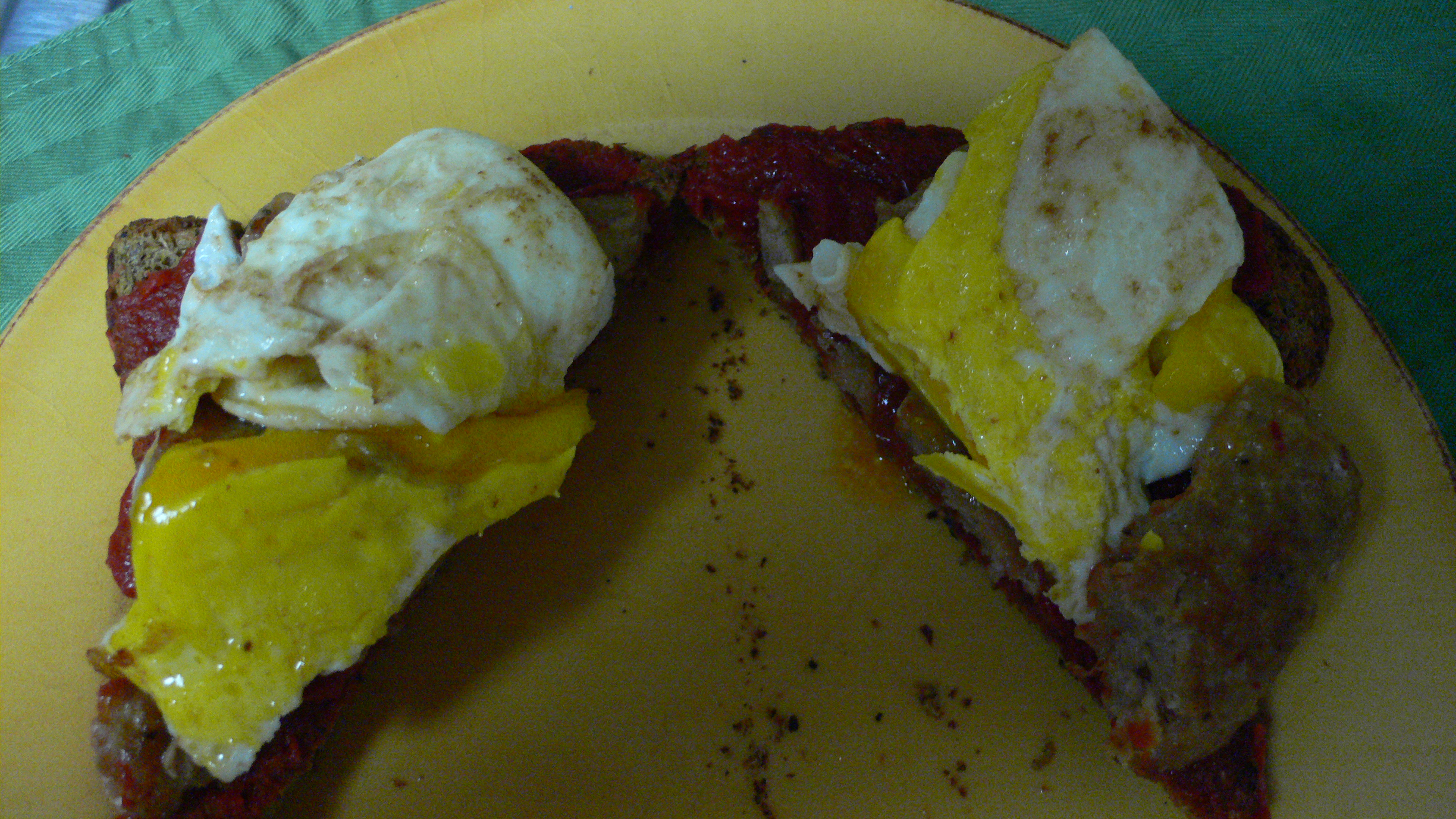
Being the lover of fiber and creative cook that I am, solutions unfolded right before my eyes.  Thanks to my new local Trader Joe’s, I concocted a more err, sophistocated breakfast sandwich.  It’s easy, filling, and oh yes, quite fatty 🙂

1 piece of sprouted rye bread, toasted (from TJ’s)
1 whole egg, cooked sunny side up (cooked in the fat of the sausage)
1 Chicken Sicilian Sausage link from TJ’s (Their brand).  Trust me, one is PLENTY.  These bad boys are big
1 tbsp tomato paste, spread on the toast.

YUM!

Great plates


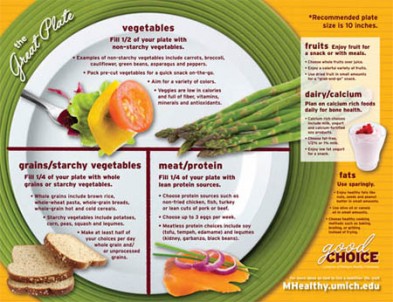
While prepping for my coaching session today I came across this handy-dandy picture that I think all of us could use as a reminder -especially right now when holiday treats are everywhere.  I like this pic because it reminds me to eat in BALANCE.  I tend to over-do it on one thing (carbs) and then want to restrict the next day to ‘make up for it’.  Ha!  When will I learn….

The more I eat in balance, the less I crave, and the better my digestion is.  For me, this time of year is a great time to sub out breads and use root veggies, like sweet potatoes and also squashes as my ‘carb’.  Gotta love that fiber.

Anyway bloggies, just a little reminder about balance on this sunny Tuesday in Davis.  I couldn’t help but notice that nowhere on this plate is the “hot chocolate” portion..hmmm…..guess I’m in denial that a daily serving of Swiss Miss isn’t good nutrition.  But hey, the box says it’s full of calcium and antioxidants, so how bad can it be 😉

Is the environment making us diabetic?

I am taking an environmental health class (SPH262 for those UC Davis folk reading).  It’s pretty interesting, but what I am finding most interesting is the interface between the nutrition and the environment. It’s kind of a new realm of discovery for me.   Think back: 100 years ago (yeah, I know YOU weren’t alive, but you can ponder human existence), environmental toxins were likely slim: maybe too much smoke because of long hours cooking over a wood-burning stove, or the reside from coal burning.  But let’s face it: the air was cleaner, and the food was cleaner too (at least from toxins).  However, of recent, with the huge surge in obesity and related diseases, scientists are hot on the trail for cause(s).

Environment and weight have been linked for a while, but mostly in the sense of our environment being “Obeseogenic” – meaning that it promotes a sedentary lifestyle, is infiltrated with junk food, and we are bombarded with messages to EAT! EAT! EAT!  But I haven’t really looked into how toxins might play a role in weight issues or diseases that relate until I read this article.

Now, before I go into sharing what I’ve read, a few caveats:  First, the research I’m reading is in animal studies.  Yes, there are similarities with people, but let’s not assume a lab rat mimics a human exactly.  Also, there are A LOT of factors that contribute to insulin resistance (which can result in diabetes, among other things).  Diet, fitness level, muscle mass, stress level and genetics also play a role.  Ultimately I believe it’s all of our responsibility to manage our own self-care to limit the influence of environmental factors in disease and obesity.

Okay, now the punchline: According to a 2010 study in Environmental Health Perspectives, Volume 118/Volume 4 (a reputable journal full of lots of science jargon), lab rats exposed to human levels of Persistant  Organic Pollutants (POPS), developed insulin resistance compared with the unexposed (no POP) rats.  The take-home is that we may want to think about the toxicants we ingest as a contributor to our diet.  POPS are found in pesticides, among other places.

My suggestion is to do two things:

1. DON’T panic- this isn’t definitive research – more work needs to be done.

2. BE PROACTIVE AND SHOP CONSCIOUSLY:  eat more local, pesticide free foods and consider alternatives to pesticides when you are tending to your own yards, etc.  POPS are also ambient, especially in the San Joaquin Valley of CA, so I saw we all take regular breaks to the Mountains and the Ocean to get away from stifling valley air.  IF you live in Oregon (my home away from this home…) – LUCKY!!!!!  Clean air and lots of awareness about environmental pollutants.

Now it makes me wonder whether or not POPS contribute to food cravings…hmm……

If at first you don’t succeed…

This is me trying to Wake board….

Not exactly my best work, but I didn’t give up.

Then just this morning I was reminded in my yoga class that today is a day of transition.  It’s the Vernal Equinox. Change time.  The fleeting of one season as the other rises.

During change things are awkward.  We don’t know what is going to happen next.  One day we wake up and it’s 90 degrees, the next day the leaves are turning and rain is pending.  One minute the Wake Board is right underneath my feet, the next minute it’s GONE!  It can feel pretty out of control, especially in our worlds which have been mostly created to give us control over everything from our climate (AC and heaters) to being able to buy every item, food, song, or whatever from the tips of our fingers.  We forget that the natural process of life is change.  We are not meant to control everything, but rather to harness the energy of change and guide to toward our personal growth.

Personal change has been a lot like this for me too.  It’s not always graceful, pretty, or comfortable (okay it is NEVER these  things), but the beauty is in the fact that it’s new – it’s evolving – it’s creation in motion.

And at the end, you might get something more like this:

now she has it!

If you are in the midst of change – changing your diet, your life, your mind or your body…remember that you are EXACTLY where you need to be.  You can’t have  the butterfly without the cocoon, you can’t have the first snow of Winter without the transitional season of Autumn.   You simply must go with the process – dance with it, embrace it and one day you will get it !  I promise!